Crown XLi 3500 vs QSC GX5: Which Budget Power Amp Is Worth Your Money?
| KEY FACTSThe Crown XLi 3500 and QSC GX5 are two of the most popular budget power amplifiers used in live sound worldwide.The Crown XLi 3500 offers more raw wattage for the price. The QSC GX5 offers better build quality and more reliable long-term performance.Both are suitable for mid-size live events, churches, and small to medium venues when used within their rated specifications.This comparison is based on real-world use in live event environments, not just datasheet numbers.Neither amplifier is universally better. The right choice depends on your application, budget, and how hard you plan to run the amp. |
If you have spent any time shopping for a budget power amplifier for live sound use, you have almost certainly come across these two names. The Crown XLi 3500 and the QSC GX5 appear on more live sound equipment lists, forum recommendations, and church audio budgets than almost any other amplifiers at their price point.
I have used both amplifiers in real live event environments. Not as a reviewer testing them on a bench, but as a working sound engineer running them through actual shows. I have run the Crown XLi 3500 through a full outdoor concert day. I have used the QSC GX5 in church installations where the amplifier runs every Sunday for years without a day off. Both have taught me things about how they perform that you cannot learn from a specification sheet.
This comparison will tell you exactly what each amplifier does well, where each one falls short, and which one is the right choice depending on what you are actually going to do with it.
The Basics: What Each Amplifier Is
Crown XLi 3500
The Crown XLi 3500 is a two-channel power amplifier from Crown Audio, a brand with decades of professional audio heritage. The XLi series sits at Crown’s entry-level price point and is designed as an affordable professional amplifier for live sound and installed sound applications.
Rated power output: 1,350 watts per channel into 4 ohms, 2,700 watts bridged mono into 8 ohms. In stereo mode into 8 ohms, the rating is 900 watts per channel.
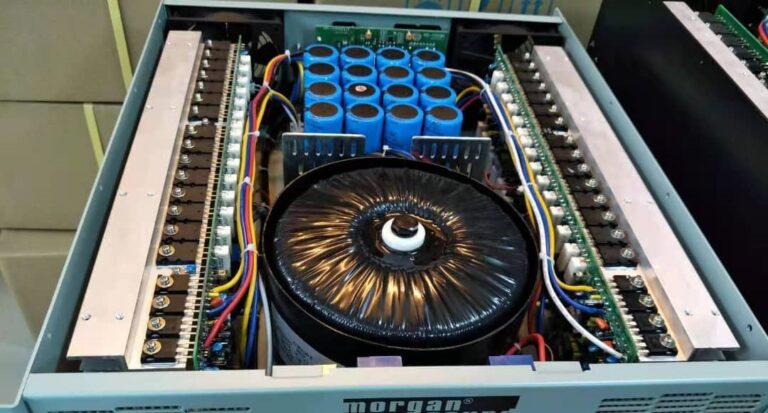
Weight: Approximately 16 kg. It is a heavy two-rack-unit amplifier with a conventional linear power supply.
Price range: Approximately $350 to $450, depending on region and retailer.
QSC GX5
The QSC GX5 is a two-channel power amplifier from QSC Audio, a company that has supplied professional amplifiers to touring productions, installed venues, and broadcast facilities for over 50 years. The GX series is QSC’s value-tier offering.
Rated power output: 700 watts per channel into 4 ohms, 500 watts per channel into 8 ohms, 1,400 watts bridged mono into 8 ohms.
Weight: Approximately 9 kg. It uses a switch-mode power supply, which is significantly lighter than the Crown’s conventional supply.
Price range: Approximately $350 to $500, depending on region and retailer.
Power Output: Does the Crown Actually Win?
On paper, the Crown XLi 3500 produces significantly more power than the QSC GX5. Nearly double in some configurations. This looks like a clear win for the Crown, and for applications where raw wattage matters above everything else, it is a genuine advantage.
But wattage numbers deserve scrutiny. The Crown XLi series uses a conventional transformer-based power supply. This type of power supply delivers excellent sustained power at moderate levels but can sag under demanding peak loads. In live sound applications with high peaks, particularly bass-heavy content driving low-impedance subwoofers, the available power in real use conditions may be lower than the rated figure suggests.
The QSC GX5 uses a switch-mode power supply. Switch-mode supplies are more efficient and maintain rated output more consistently under load. The GX5 produces less power on paper, but that power is delivered with greater consistency.
The practical implication: if you are driving two 8-ohm full-range speakers at moderate to high levels, both amplifiers have more than enough power. If you are running the amplifier hard into difficult loads at sustained high levels, the QSC’s power delivery consistency gives it a real-world advantage that the Crown’s higher rated wattage does not overcome.
| Specification | Crown XLi 3500 | QSC GX5 |
| Power at 8 ohms stereo | 900W per channel | 500W per channel |
| Power at 4 ohms stereo | 1,350W per channel | 700W per channel |
| Bridged mono at 8 ohms | 2,700W | 1,400W |
| Weight | 16 kg | 9 kg |
| Power supply type | Conventional linear | Switch mode |
| Cooling | Forced air front to rear | Forced air front to rear |
| Signal to noise ratio | Greater than 100 dB | Greater than 100 dB |
Build Quality and Reliability
This is where the two amplifiers diverge most meaningfully in practice, and it is the reason this comparison is not as simple as choosing the one with more watts.
The QSC GX5’s build quality is noticeably superior to the Crown XLi 3500. QSC’s manufacturing standards are consistently higher at comparable price points. The chassis construction, the quality of the rear panel connectors, the fader controls, and the internal component selection on the GX5 all feel more professional than the XLi 3500.
In a church installation where the amplifier runs every Sunday for five years without complaint, this build quality difference matters enormously. The QSC GX5 has a strong track record as a reliable installed sound amplifier. The Crown XLi 3500 is a more appropriate choice for a touring or event hire context where the amplifier is not run continuously and where occasional servicing is part of the operating model.
The XLi 3500’s conventional power supply also runs warmer than the QSC’s switch-mode supply. In a closed rack with limited ventilation, the Crown will require more active cooling management to avoid thermal shutdowns. The QSC runs cooler in most operating conditions.
Sound Quality
Both amplifiers are transparent at moderate listening levels, meaning they add no obvious character or coloration to the signal. In a well-configured live sound system, you should not be able to identify which amplifier is in the rack by its sonic signature alone when both are operating in their comfortable operating range.
The differences emerge at high output levels. As the Crown XLi 3500 approaches its limits, the sound character can become slightly compressed or hardened before the clip light illuminates. The QSC GX5’s clipping behaviour is cleaner and more abrupt, which some engineers prefer because the transition from clean to clipped is easier to identify and correct.
For speech reinforcement in a church or corporate presentation environment, both amplifiers are entirely adequate and indistinguishable. For critical music reproduction where you are pushing the amplifier into higher output territory, the QSC’s more consistent power delivery and cleaner clipping behaviour give it an edge.
Inputs and Connectivity
Both amplifiers accept balanced XLR and TRS jack inputs on each channel. Both include a sensitivity switch allowing you to select input sensitivity to match the output level of your mixing console. Both provide binding post and Speakon speaker outputs.
One practical difference: the QSC GX5’s rear panel layout is slightly more accessible and the connector labelling is clearer. In a dark rack at the back of a venue, this is a minor but real practical advantage.
Which Application Suits Each Amplifier?
Choose the Crown XLi 3500 if:
- You need maximum wattage for the lowest possible price. For driving large passive subwoofers where bridged mono power output is the primary requirement, the Crown’s higher bridged rating (2,700W vs 1,400W) is a genuine advantage.
- You are using the amplifier for occasional events rather than continuous fixed installation. The Crown performs well in touring or event contexts where it is used intensively for short periods and then stored.
- Your budget is fixed at the lower end of this bracket. The Crown XLi 3500 is often available at slightly lower prices than the QSC GX5 and delivers more wattage for the money in those situations.
- You are driving very low impedance loads. The Crown XLi 3500 is stable into 2 ohms per channel in stereo, which the QSC GX5 does not support. If you are running multiple passive speakers in parallel configurations that result in 2-ohm loads, the Crown handles this, where the QSC cannot.
Choose the QSC GX5 if:
- You are installing the amplifier in a permanent venue or church and need long-term reliability. The QSC’s build quality, cooler running temperature, and superior track record in installed sound environments make it the better long-term investment.
- You are running the amplifier at high duty cycles. For applications where the amplifier is on and working for extended periods continuously, the switch-mode power supply and superior thermal management of the GX5 reduce the likelihood of thermal shutdowns and component stress.
- Weight matters for your setup. The GX5 is nearly half the weight of the XLi 3500. For a touring rig where rack weight is a concern, this difference is significant across multiple amplifiers.
- You want more consistent power delivery under load. The switch-mode power supply maintains output more consistently when the amplifier is being worked hard, which matters for professional applications.
Real World Verdict
After using both amplifiers across a range of real events, my honest assessment is that the QSC GX5 is the better amplifier for most professional and semi-professional applications. It is better built, runs cooler, and delivers more consistent performance over its operational life.
The Crown XLi 3500 wins on raw wattage and wins when budget is the absolute constraint. If you need a bridged mono amplifier for a large passive subwoofer system and 2,700 watts at the lowest possible price is the requirement, the Crown delivers that. But if you are building a system you want to rely on for years, the QSC GX5 earns its price premium.
The best advice I can give: do not buy either amplifier based on the wattage rating alone. Buy based on how and where you will use it. Both are capable, well-known amplifiers. Choosing correctly between them is about matching the amplifier’s characteristics to your specific application, not about which number on the spec sheet is larger.
Frequently Asked Questions
Can either of these amplifiers drive a line array speaker system?
Both can drive individual line array elements when the impedance and power requirements of the specific elements fall within each amplifier’s rated range. However, professional line array systems with multiple elements are typically driven by amplifiers specifically designed for that application, such as the Crown XTi or QSC PLX series, which include built-in DSP for crossover and time alignment functions. The XLi 3500 and GX5 are better suited to driving conventional passive speaker cabinets.
Is the Crown XLi 3500 truly stable at 2 ohms?
Crown rates the XLi 3500 as 2-ohm stable per channel in stereo mode. However, running any amplifier continuously at 2 ohms generates significant heat and stresses the output stage. The amplifier will work at 2 ohms but requires excellent ventilation and should not be run at full output for extended periods at this impedance. Use 2-ohm operation as an occasional capability rather than a design basis for your speaker system.
Which amplifier has better warranty support?
Both Crown and QSC are owned by the same parent company (Harman International) and offer standard manufacturer warranties. QSC has a long-standing reputation for responsive customer service and accessible technical support, which many engineers consider a practical advantage of the brand. Both brands have authorised service centres in most major markets.
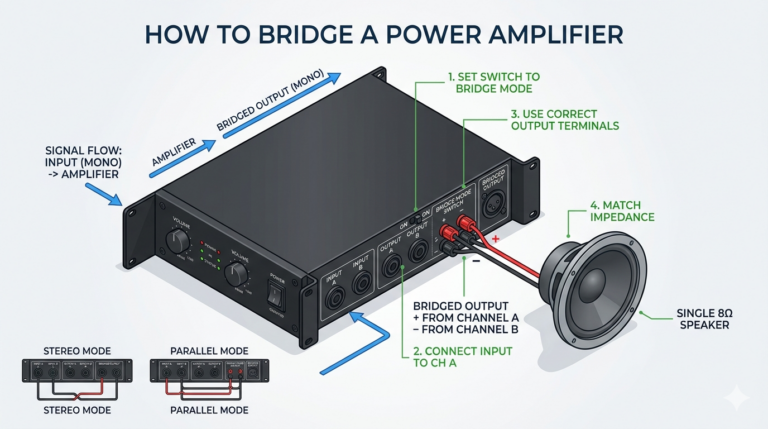
Can I bridge both amplifiers for subwoofer use?
Yes, both amplifiers support bridged mono operation. In bridged mode, the Crown XLi 3500 delivers 2,700 watts into 8 ohms, and the QSC GX5 delivers 1,400 watts into 8 ohms. Note that when bridging, the minimum speaker impedance doubles, meaning an amplifier that can drive 4 ohms per channel in stereo mode can only drive 8 ohms when bridged. Always check the minimum bridged impedance in the amplifier’s manual before connecting speakers in bridged mode.