Subwoofer Placement Guide for Live Sound: Where to Put Your Subs for Maximum Impact
| KEY FACTS: Subwoofer placement has a larger effect on bass quality and coverage than almost any other variable in a live sound system. The standard practice of stacking all subs together in the centre creates an omnidirectional bass pattern that wastes energy toward the stage. Cardioid and end-fire sub arrays significantly improve front-to-back bass control, reducing stage bleed and feedback potential. Bass frequencies are non-directional above approximately 80 Hz, but sub placement still has a significant effect on coverage consistency. This guide covers conventional placement, split sub configurations, cardioid arrays, and end-fire arrays with practical instructions for each. |
Of all the variables in a live sound system, subwoofer placement is the one that most engineers either do not think about at all or think about in a superficial way. The most common approach is to stack all the subwoofers in a single cluster in front of the stage, aim them at the audience, and accept whatever bass distribution results. This works, but it is far from the best approach, and it creates problems that are not immediately obvious but become familiar over time: too much bass on stage causing feedback, uneven bass coverage across the audience, and wasted output going in directions where nobody is listening.
This guide covers how bass actually behaves in a live sound environment, why placement matters more than most engineers realise, and the specific configurations that professional systems use to get better results from the same subwoofer hardware. Better sub placement does not cost extra money. It costs preparation and understanding.
How Bass Behaves Differently From High Frequencies
High-frequency sound is highly directional. Point a tweeter in a direction and the energy goes predominantly in that direction. Bass is different. Below approximately 80 to 100 Hz, sound wavelengths are long enough (3.4 metres at 100 Hz, 17 metres at 20 Hz) that the sound does not behave as a directed beam. Bass radiates in all directions from the source, which is why you can hear the bass from a subwoofer whether you are in front of it, behind it, or beside it.
This omnidirectional radiation behaviour is the root of both the challenges and the solutions in subwoofer placement. Because bass goes everywhere, a single subwoofer cluster sends equal energy toward the audience, toward the stage, toward the sides of the room, and into the floor and ceiling. The energy going toward the stage is what causes bass buildup on stage, increases feedback potential with microphones on stands or lapels, and makes it harder for musicians to hear their monitor mixes clearly. The energy going to the sides and rear is wasted.
However, because bass wavelengths are long, multiple subwoofers arranged deliberately in specific patterns can create constructive and destructive interference that concentrates bass energy in useful directions (toward the audience) and reduces it in unwanted directions (toward the stage). This is the principle behind cardioid and end-fire sub arrays.
Conventional Centre Cluster Placement
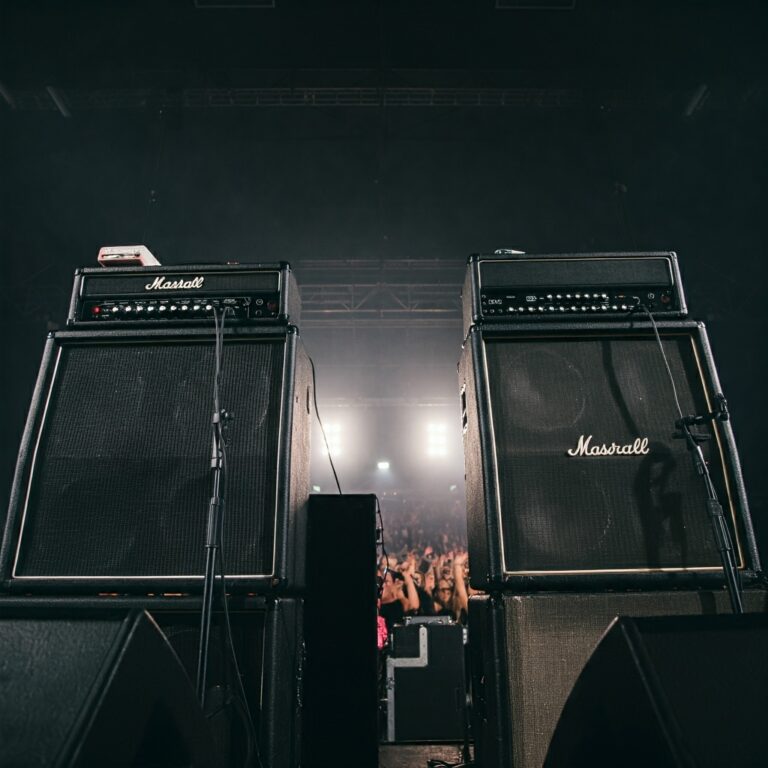
The most common subwoofer placement in small to medium live events is a centre cluster: all subwoofers stacked together in a single group, typically underneath or alongside the main left and right speaker stacks, centred in front of the stage.
When this approach works well: For small events with limited space, simple setups, and audiences that are relatively close to the subwoofers (within 10 to 15 metres), a centre cluster delivers adequate bass coverage without the complexity of more sophisticated configurations. For events where simplicity and speed of setup are priorities, a centre cluster is a reasonable default.
The limitations: Bass from a centre cluster radiates equally toward the stage and toward the audience. Performers on stage experience significant bass energy from the subs, which can make monitoring difficult and increase the risk of microphone feedback. Coverage across a wide audience area can also be uneven, with people directly in front of the cluster receiving more bass than people at the sides of the audience.
Split Sub Placement
Split sub placement puts subwoofers on both sides of the stage, aligned with the main left and right speaker stacks, rather than clustering all subs in the centre. For example, instead of four subwoofers in a centre stack, you place two subs on the left side under the left main speaker and two subs on the right side under the right main speaker.
The advantages: Bass coverage is wider and more even across a broad audience area because the left and right sub clusters are physically separated. For wide stages and wide audience areas, this can produce significantly better coverage consistency than a single centre cluster.
The limitation: At the centre of the audience, the bass from both left and right sub clusters arrives at almost identical times and combines. Depending on the listening distance and the frequency, this combination can produce either reinforcement or cancellation, creating an unpredictable centre response. Split subs work better at distances beyond approximately 15 to 20 metres from the stage where the relative timing differences between left and right clusters become negligible.
The Cardioid Subwoofer Array
A cardioid subwoofer array is one of the most effective techniques for controlling bass directionality. The name comes from the cardioid (heart-shaped) polar pattern it creates: strong bass output toward the audience, significantly reduced bass output toward the stage.
A cardioid sub array is achieved by combining forward-facing and rear-facing subwoofers with specific delay and polarity settings. The rear-facing subwoofer fires toward the stage and is processed with a delay and polarity inversion that causes its output to cancel the forward-facing subwoofer’s output toward the stage while reinforcing it toward the audience.
Basic Cardioid Configuration
The simplest cardioid configuration uses pairs of subwoofers. Within each pair:
- One subwoofer faces forward toward the audience (standard orientation).
- One subwoofer faces backward toward the stage.
- The rear-facing subwoofer receives the same signal as the forward-facing one but with the polarity inverted (use the polarity inversion switch on your amplifier or processor for this channel) and a delay applied equal to the time sound takes to travel the distance between the two subwoofer front faces.
For two subwoofers with their front faces approximately 0.8 metres apart, the delay applied to the rear-facing sub is approximately 2.3 milliseconds (calculated as 0.8 metres divided by 343 metres per second, the speed of sound).
The result is a pattern where bass toward the audience is reinforced and bass toward the stage is reduced by 15 to 20 dB. This means the performers on stage experience significantly less bass energy from the subs, stage feedback potential is reduced, and the bass energy is concentrated where it is useful.
Important Considerations for Cardioid Arrays
- The cardioid effect is frequency-dependent. The array works best across a specific frequency range determined by the spacing between the forward and rear-facing units. For typical subwoofer spacing of 0.8 to 1.0 metres, the cardioid effect is most pronounced between approximately 60 and 120 Hz.
- You need more total subwoofers. A cardioid pair delivers approximately the same forward output as a single conventional subwoofer, because one of the two units is facing backward. To maintain the same forward output as a conventional cluster, you need twice as many subwoofers in a cardioid configuration.
- Many digital processors and amplifiers have dedicated cardioid sub presets. If your system includes a DSP processor from a major manufacturer, look for cardioid or end-fire presets before manually calculating delay times. These presets have been validated by the manufacturer’s engineering team.
The End-Fire Subwoofer Array
An end-fire array is another approach to achieving forward-focused bass directivity. Unlike the cardioid array which uses both forward and rear-facing units, an end-fire array uses all subwoofers facing forward but spaced in a line from front to back, with progressive time delays applied to the rear units.
The delay settings cause the rear subwoofers to fire slightly before the front ones, so that by the time the rear subwoofers’ bass propagates through the stack to reach the front, all the signals arrive at the front face of the stack at the same time and in phase with each other. In the forward direction toward the audience, the outputs add constructively. Behind the stack (toward the stage), the signals arrive at different times and cancel each other.
An end-fire array can achieve 15 to 25 dB of front-to-back discrimination, similar to or better than a cardioid array, without the constraint of rear-facing enclosures. It does require physical depth (the subwoofers must be spaced fore-and-aft rather than side-by-side), which may not be practical in all stage setups.
Practical Recommendations for Different Event Sizes
Small Events: up to 200 People
At this scale, a standard centre cluster or split sub configuration is entirely appropriate. The complexity and hardware requirements of cardioid or end-fire arrays are not justified for events of this size. Focus on correct time alignment between the subs and the full-range speakers, and ensure the subs are positioned as close to the stage front as practical to keep the bass tight and focused.
Medium Events: 200 to 800 People
At this scale, the benefits of cardioid or end-fire sub placement start to become meaningful, particularly if the stage has significant microphone coverage and feedback is a recurring concern. A simple cardioid pair configuration on each side of the stage, or an end-fire stack in the centre, provides meaningful stage bleed reduction without requiring a large investment in additional hardware.
Large Events: 800 People and Above
At this scale, professional subwoofer array design is a standard part of system setup. Most professional touring systems at this level use cardioid or end-fire configurations as the default, and the system processor will include presets for the specific subwoofer cabinets in use. Work with the manufacturer’s software to optimise the array for the specific venue dimensions and audience layout.
Time Aligning Subwoofers to the Full-Range System
Regardless of which subwoofer placement configuration you use, time alignment between the subwoofers and the full-range speakers is essential for coherent bass. In a stacked system where the main speakers sit on top of the subwoofers, the full-range speakers are physically further from the audience than the subwoofer fronts. This means the high frequencies from the main speakers arrive at the listening position slightly later than the bass from the subs.
Apply a delay to the subwoofer output equal to the time it takes sound to travel from the main speaker to the subwoofer front face. For a system where the main speaker is 0.5 metres higher than the sub front (a very common configuration), this delay is approximately 1.5 milliseconds.
In a ground-stacked system with the main speakers elevated significantly above the subs, the delay may need to be substantially larger. Use a measurement microphone and real-time analysis software (such as Rational Acoustics Smaart or the free Room EQ Wizard) to verify the time alignment at the listening position.
Frequently Asked Questions
Does subwoofer placement matter in a small church or venue?
Yes, even in small venues. A subwoofer placed in a corner of the room will be reinforced by the room boundaries and sound significantly louder and boomy compared to the same subwoofer placed away from the corners. In a small venue, placing the subwoofer along the front wall of the room (rather than in a corner) and applying a high-pass filter to all full-range channels reduces the bass buildup that makes small rooms sound muddy.
Why does the bass sound different at different positions in the audience?
Bass coverage is inherently less even than high-frequency coverage because of the long wavelengths involved. Room modes (resonant frequencies determined by the room dimensions) reinforce bass strongly at some positions and cancel it at others. In a live event space, these modes interact with the subwoofer placement to create the coverage pattern. Measurement software can identify these modes and guide both placement decisions and EQ corrections to even out the coverage.
Can I use a subwoofer on its side?
Subwoofer cabinets are typically designed to be used in a specific orientation. Using a subwoofer on its side may change the port direction (in ported cabinets), affect internal resonances, or place mechanical stress on the driver surround in ways the design did not account for. Check the manufacturer’s documentation for approved operating orientations before using a cabinet in a non-standard position.