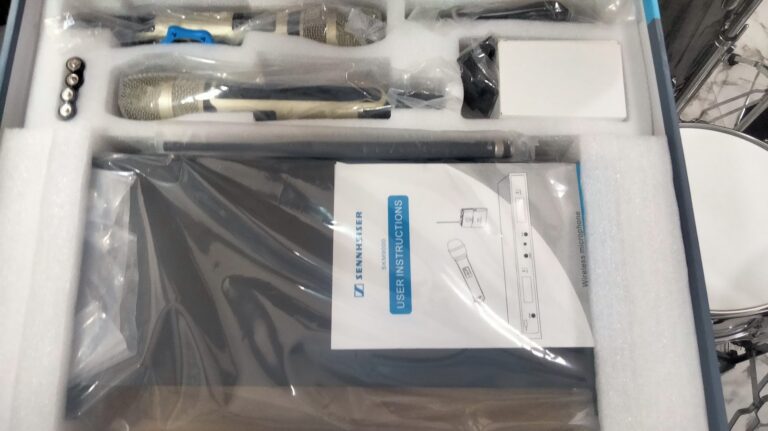
The Professional Microphone Selection Guide: How to Choose for Your Venue
Selecting the proper microphone for live applications involves analyzing your ambient environment, your wireless frequency spectrum, and your gain-before-feedback thresholds.
If you need to instantly narrow down your choices based on capsule type, connector format, and specific polar configurations, launch our custom interactive Microphone Selector Tool to secure your venue’s ideal audio configuration.
Dynamic vs. Condenser: Matching the Room Acoustics
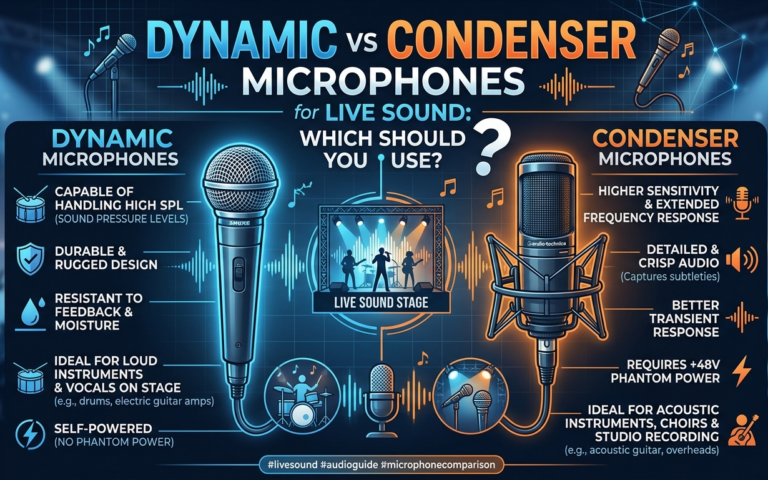
The primary decision point when selecting a vocal or instrument microphone rests on the transducer topology:
Dynamic Microphones
Dynamic microphones utilize a moving coil and a robust diaphragm. They feature a lower inherent sensitivity, making them excellent for rejecting off-axis background noise.
- Best For: Untreated rooms, loud live stages, and classrooms where acoustic reflections create unwanted echoes or ringing frequencies.
Condenser Microphones
Condenser microphones utilize an ultra-thin gold-sputtered capsule diaphragm that requires external DC power (48V Phantom Power). They provide excellent transient response and high-frequency articulation.
- Best For: Acoustically treated studio spaces or controlled performance environments where subtle nuances need to be captured.
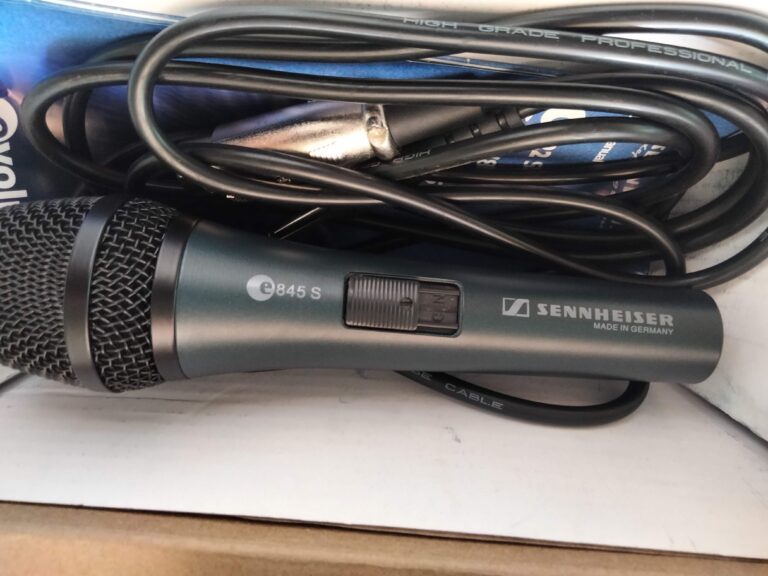
Head-to-Head: Sennheiser e835 vs. Shure SM58
For live speech and lead vocals, the two industry standards are the Shure SM58 and the Sennheiser e835. While both are dynamic cardioid options, they feature distinct sonic signatures:
- Shure SM58: Features a pronounced mid-range presence peak centered around $2\text{ kHz} – 4\text{ kHz}$. It helps vocals cut cleanly through dense, loud instrument mixes, though it can sometimes sound slightly muddy or boxy in the lower mid-frequency range ($200\text{ Hz}$) on deeper voices without corrective EQ.
- Sennheiser e835: Delivers a more extended high-frequency presence shelf that stretches up toward $12\text{ kHz}$. This provides a brighter, more clear top-end response that helps flatter speech intelligibility in reverberant venues without requiring heavy board processing.
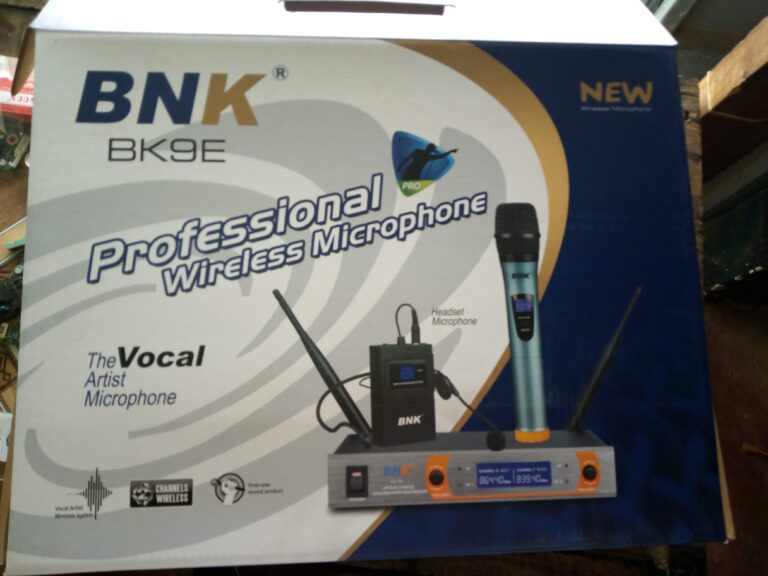
Wireless Architecture: What Does UHF Mean on a Microphone?
When choosing a wireless system, the operating frequency range determines your system stability and drop-out resistance.
UHF (Ultra High Frequency) wireless microphones operate within the $300\text{ MHz}$ to $3\text{ GHz}$ radio spectrum. Compared to VHF (Very High Frequency) systems ($30\text{ MHz}$ to $300\text{ MHz}$), UHF provides shorter wavelengths, allowing for highly efficient, compact internal diversity antennas and significantly higher channel counts without frequency crowding.
| Feature Profile | UHF Wireless Systems | VHF Wireless Systems |
| Frequency Range | 470 MHz- 608MHz(Standard TV Band) | 174 MHz – 216MHz |
| Spectral Crowding | Low to Moderate (Highly clear outside city centers) | High (Susceptible to taxi radios and line noise) |
| Signal Penetration | Strong line-of-sight performance | Better physical obstacle penetration over long distances |
Solving Live Feedback and Echo Issues
To prevent feedback loops (that high-pitched squealing sound) when deploying a microphone in a live space or a classroom, follow the laws of acoustic physical isolation:
- Keep the Microphone Behind the Main FOH Speakers: Never allow a presenter or vocalist to walk directly in front of your house PA speakers.
- Exploit the Capsule Nuance: Cardioid and supercardioid microphones reject sound directly from the rear ($180^{\circ}$ off-axis). Angle your stage monitors or floor fills so they fire directly into the dead zone of your microphone’s specific polar pattern.
- Ring Out the Room: Use a parametric or graphic equalizer to pull down the specific resonant frequencies that are causing early feedback loops.
Find Your Perfect Match
If you need to instantly narrow down your choices based on capsule type, connector format, and specific polar configurations, launch our custom interactive Microphone Selector Tool to secure your venue’s ideal audio configuration.