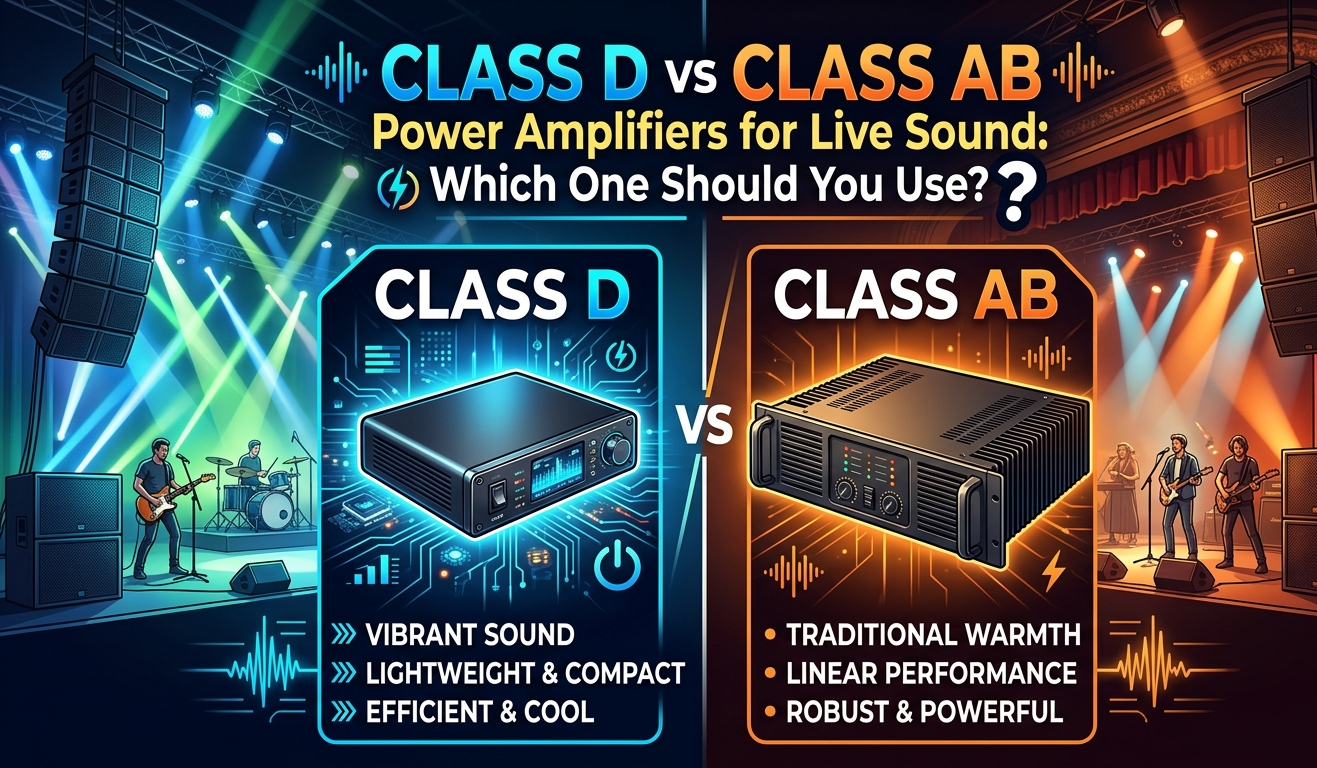
Class D vs Class AB Power Amplifiers for Live Sound: Which One Should You Use?
| KEY FACTS: Class AB amplifiers have been the live sound standard for decades. Class D has largely overtaken them for touring and installation work in recent years. Class D amplifiers are lighter, run cooler, and are more energy efficient. Class AB amplifiers have a longer track record, and some engineers prefer their behaviour under load. For most live sound applications today, a quality Class D amplifier from a reputable manufacturer is the practical choice. The difference in sound quality between well-designed Class D and Class AB is far smaller than the difference in weight, heat, and power consumption. This guide explains what each class actually does, where each one excels, and how to choose for your specific situation. |
When I started in live sound, the debate between amplifier classes was not really a debate at all. Class AB was what professional live sound amplifiers used, and if someone mentioned Class D, the reaction from most engineers was scepticism. Class D was the technology in cheap consumer products and car audio, and it had a reputation for harsh, thin sound that professional engineers rightly dismissed.
That picture has changed completely. Modern Class D amplifier designs, particularly from companies like Crown, QSC, Lab.gruppen, and powersoft, have closed the gap in sound quality dramatically while maintaining the practical advantages that make Class D compelling for live sound use. Today, the majority of professional touring amplifiers shipped worldwide are Class D, and that shift happened because working engineers chose them based on real results, not marketing.
This guide explains what these two amplifier classes actually are, how they differ in practice, and which one makes sense for your specific situation.
What Class AB Actually Means
Class AB is a hybrid of two earlier designs. Class A amplifiers run their output transistors continuously, which produces extremely low distortion but wastes enormous amounts of power as heat. Class B amplifiers split the signal between two output devices, each handling half the waveform, which is efficient but introduces a distortion artefact at the crossover point where one device hands off to the other.
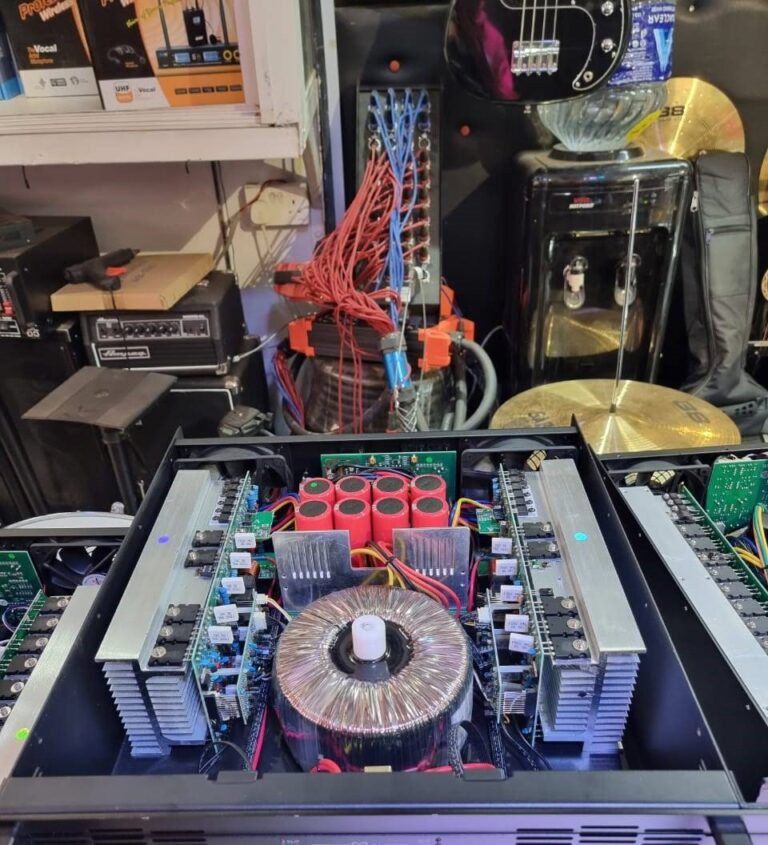
Class AB solves the crossover distortion problem by having both output devices conduct a small amount of current continuously, even when no signal is present. The result is low distortion across the full signal range with efficiency typically in the range of 50 to 70 percent. The remaining 30 to 50 percent of the power drawn from the mains is dissipated as heat, which is why Class AB amplifiers require large heat sinks, forced-air cooling, and run significantly warmer than Class D equivalents.
For decades, Class AB was the dominant design in professional audio because it produced clean, reliable, well-understood results. The behaviour of a well-designed Class AB amplifier under load is predictable and consistent, and professional engineers developed a deep familiarity with how these amplifiers respond to difficult speaker loads, clipping conditions, and sustained high-output operation.
What Class D Actually Means
Class D operates on a fundamentally different principle. Instead of amplifying the audio signal directly, a Class D amplifier converts the audio signal into a high-frequency series of pulses (pulse-width modulation or PWM) where the width of each pulse represents the amplitude of the audio signal at that moment. These pulses switch the output transistors fully on or fully off at rates typically between 300 kHz and 500 kHz. A low-pass filter at the output reconstructs the audio signal from these pulses before it reaches the speaker.
Because the output transistors are always either fully on or fully off (never partially conducting), very little power is wasted as heat in the output stage. Modern Class D amplifier designs achieve efficiency ratings of 85 to 95 percent, meaning 85 to 95 cents of every dollar of electrical power drawn from the mains becomes useful audio output rather than heat.
This efficiency translates directly into practical advantages. Less heat means smaller heat sinks. Smaller heat sinks combined with modern switch-mode power supplies mean the amplifier can be made dramatically lighter and more compact. A Class D touring amplifier that delivers 3,000 watts per channel might weigh 10 kg. A Class AB amplifier delivering equivalent power could weigh 25 to 35 kg.
The Sound Quality Question: Does Class Really Matter?
This is the question most engineers ask first, and it is the one where the answer has changed most significantly over the past decade. In early Class D designs, the sound quality difference was real and audible. Early implementations had issues with high-frequency noise from the switching frequency bleeding into the audio band, and some designs behaved poorly with reactive speaker loads (speakers whose impedance varies significantly with frequency, as all real-world speakers do).
Modern Class D designs from professional manufacturers have addressed these problems comprehensively. The switching frequency is now high enough that the filter requirements are much less demanding. Feedback control loops have been refined to compensate for reactive loads. And the output filter designs have been optimised to maintain flat frequency response and low distortion across the full audio bandwidth regardless of speaker impedance.
In a properly configured live sound system, the sound quality difference between a well-designed modern Class D amplifier and a well-designed Class AB amplifier of equivalent specification is not audible in practical conditions. Both produce flat frequency response, low distortion at normal operating levels, and clean, transparent amplification of the audio signal.
Where differences do emerge is at the extremes. A Class AB amplifier clips in a way that many engineers describe as more gradual and somewhat more forgiving than the clipping behaviour of some Class D designs. The thermal behaviour of Class AB under sustained high-output conditions is also more familiar to engineers who have spent years working with it. These are real differences, but they are operating-condition differences rather than fundamental sound quality differences at normal operating levels.
Practical Comparison for Live Sound Use
Weight and Portability
This is where Class D wins decisively and without qualification. A touring rack of four Class D amplifiers might weigh 40 kg. The same power from Class AB amplifiers might require 80 to 120 kg of rack weight. For touring productions where equipment is loaded in and out of vehicles and venues repeatedly, this difference is significant for both logistics and crew health.
For fixed installations where the amplifier goes into a rack once and stays there, weight matters less. But even in fixed installations, lighter equipment is easier to install and easier to service.
Heat Generation and Ventilation Requirements
Class AB amplifiers generate significant heat that must be managed. A professional touring rack of Class AB amplifiers requires active ventilation, careful rack spacing, and in hot environments, active cooling. Thermal shutdowns from inadequate ventilation are one of the most common failure modes of Class AB amplifiers in poorly ventilated rack cases.
Class D amplifiers run substantially cooler. The ventilation requirements are less demanding, and thermal shutdown from normal operation is much rarer. For outdoor events in high ambient temperatures, for cramped fixed installations with limited airflow, and for touring situations where the rack case may not be optimally ventilated, this thermal advantage is meaningful.
Power Consumption and Generator Requirements
At a large outdoor event powered by generators, the efficiency difference between Class D and Class AB translates directly into generator sizing. A system delivering 20,000 watts of audio output from Class D amplifiers at 90 percent efficiency draws approximately 22 kW from the generator. The same audio output from Class AB amplifiers at 60 percent efficiency draws approximately 33 kW. That difference can determine whether you need a 30 kVA or 50 kVA generator, with significant cost implications.
Reliability and Track Record
Class AB has a longer track record in professional live sound, and there is genuine value in that familiarity. Service technicians who have repaired hundreds of Class AB amplifiers over decades understand these circuits deeply. Spare parts are available. The failure modes are well understood.
Modern professional Class D amplifiers have now accumulated enough field hours to demonstrate their reliability. Crown’s XTi and DCi series, QSC’s PLD and CX series, and Lab.gruppen’s PLM series have all proven themselves in demanding touring and installation environments. Reliability concerns about Class D that were legitimate ten years ago are no longer applicable to current professional designs from major manufacturers.
Which Should You Choose?
Choose Class D if:
- You are building a touring rig or mobile event system where weight and portability matter. The weight savings over an equivalent Class AB system are dramatic and compound across every amp in the rack.
- You are installing amplifiers in a location with limited ventilation. Class D runs cooler and is less vulnerable to thermal problems in sub-optimal rack environments.
- You are running the system on generator power at outdoor events. The efficiency advantage reduces generator load significantly.
- You are purchasing new amplifiers for a professional or semi-professional system today. Modern Class D from reputable manufacturers delivers professional performance at professional reliability levels.
Choose Class AB if:
- You already own reliable Class AB amplifiers that perform well. There is no compelling reason to replace functioning, well-performing Class AB amplifiers simply to adopt Class D.
- You are in a service environment where Class AB repair capability is stronger than Class D. In markets where Class D amplifier technicians are rare and Class AB repair is well established, the practical serviceability advantage may favour Class AB.
- You are driving unusual or reactive speaker loads and want the most conservative, predictable amplifier behaviour. Class AB’s behaviour with reactive loads is the more established known quantity, though modern Class D handles these loads very well.
| Factor | Class AB | Class D |
| Efficiency | 50 to 70 percent | 85 to 95 percent |
| Heat generation | High, large heat sinks needed | Low, minimal heat sinks |
| Weight (equivalent power) | Heavy | Significantly lighter |
| Sound quality (modern designs) | Excellent | Excellent |
| Track record in live sound | Decades of proven use | Now well established |
| Cost (equivalent power) | Often lower for used gear | Competitive for new gear |
| Best application | Fixed install, existing inventory | Touring, mobile rigs, new systems |
Frequently Asked Questions
Is Class D amplification suitable for subwoofers?
Yes. Class D amplifiers are widely used for subwoofer duty in professional systems. The efficiency advantage is particularly valuable for subwoofer amplifiers, which need to deliver large amounts of sustained power at bass frequencies. Many professional powered subwoofer systems use Class D amplification internally.
Why do some audio engineers still prefer Class AB?
Familiarity is a significant factor. Engineers who have worked with Class AB for many years have developed an intuitive understanding of how these amplifiers behave, how they clip, and how they respond to demanding conditions. This familiarity has genuine professional value. Some engineers also prefer the subjective character of Class AB clipping for certain applications, though this is a minority position in professional live sound today.
Do Class D amplifiers require any special considerations for speaker connections?
Most professional Class D amplifiers are designed for standard speaker loads (4 to 16 ohms) and use standard Speakon and binding post connections. Some Class D designs are more sensitive to the speaker cable characteristics (particularly cable capacitance) than Class AB designs. For very long speaker cable runs, consult the amplifier manufacturer’s recommendations for maximum cable capacitance or cable length.
Are there applications where Class D is still not appropriate?
For some audiophile and mastering applications where the absolute lowest possible noise floor and the most transparent possible amplification are required regardless of cost, size, or efficiency, some engineers still prefer Class A or Class AB designs. In live sound, these differences are rarely audible or relevant in the context of a full production system.