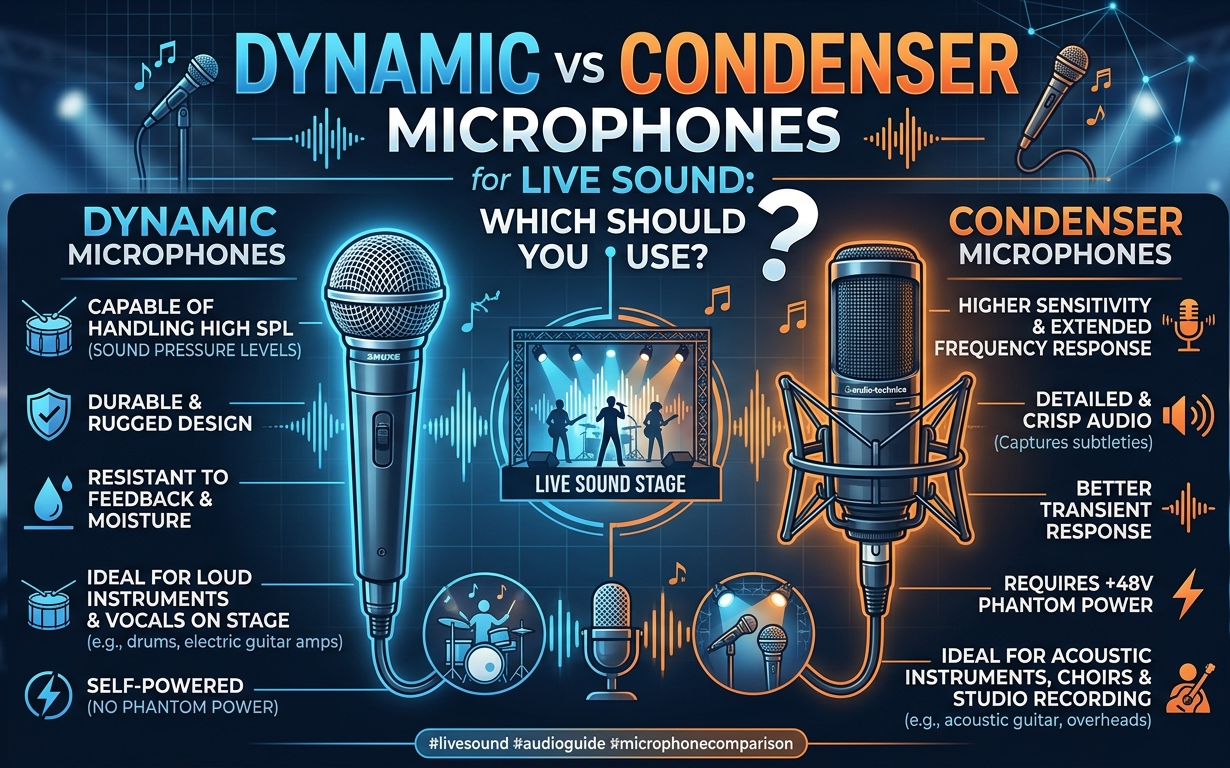
Dynamic vs Condenser Microphones for Live Sound: Which Should You Use?
| KEY FACTS Dynamic microphones are the dominant choice for live sound vocals and instruments for good practical reasons: durability, feedback rejection, and no power requirement. Condenser microphones capture more detail and have a more extended frequency response, but they are more sensitive to feedback and less durable in live environments. The choice is not always obvious, and the best live engineers use both types strategically depending on the specific application. This guide focuses specifically on live sound use, not studio recording, where the considerations are very different. Understanding the physics behind each type helps you make the right choice for each specific microphone position. |
The dynamic versus condenser debate is one of the oldest in audio. In studio recording, condenser microphones are often the default choice for their extended frequency response and high sensitivity. In live sound, the conversation is more nuanced, and the default choice is more often dynamic. But default choices are not always the right choices, and the best live sound engineers use both types thoughtfully, choosing based on the specific requirements of each microphone position.
This guide focuses specifically on live sound use, where the practical considerations are fundamentally different from a recording studio. Feedback rejection, durability, phantom power logistics, sensitivity to stage noise, and the ability to handle loud sources at close range all weigh differently in live sound than in studio recording.
How Dynamic Microphones Work
A dynamic microphone uses electromagnetic induction to convert sound into an electrical signal. A diaphragm attached to a coil of wire moves within the field of a permanent magnet when sound waves hit it. This movement induces a current in the coil, which is the audio signal.
Because the conversion principle is mechanical and electromagnetic rather than electronic, dynamic microphones do not require any external power to operate. They are robust, tolerant of rough handling, resistant to moisture, and capable of handling extremely high sound pressure levels without distorting. These characteristics make them the natural choice for the most demanding live sound applications.
Dynamic microphones also have a naturally limited high-frequency response compared to condensers. The diaphragm and coil system has more mass than a condenser capsule, which makes it less responsive to the fastest variations in air pressure that represent high-frequency sound. This is a limitation in some applications and an advantage in others.
How Condenser Microphones Work
A condenser microphone uses a capacitor (historically called a condenser) to convert sound into an electrical signal. A very thin, lightweight diaphragm is stretched close to a rigid backplate, forming the two plates of a capacitor. When sound waves move the diaphragm, the capacitance changes, and this change is converted to an audio signal by internal electronics.
Because the diaphragm is extremely lightweight, condenser microphones respond to very high-frequency sounds with far greater accuracy than dynamic microphones. The result is an extended, detailed high-frequency response that captures the air and nuance of acoustic sources more accurately. The tradeoff is that the internal electronics require power (phantom power from the mixing console, typically 48 volts), the diaphragm is more physically fragile, and the higher sensitivity means the microphone picks up a wider range of sounds including unwanted stage noise and room reflections.
Feedback Rejection: The Critical Live Sound Factor
Of all the differences between dynamic and condenser microphones in live sound, feedback rejection is the one that most directly determines which type is appropriate for a given application.
Condenser microphones are significantly more sensitive than dynamics. This higher sensitivity is what allows them to capture quiet acoustic details, but it also means they pick up more of the sound coming from the PA speakers. In a live sound environment where speakers are loud and microphones are close to those speakers, condenser microphones reach the feedback threshold at lower gain settings than equivalent dynamic microphones. This reduces the maximum volume the system can achieve before feedback.
For a vocal microphone held by a performer who moves around the stage, the feedback implications are direct and significant. Dynamic microphones allow the system to be run at higher gain before feedback occurs. This is why dynamic microphones dominate live vocal applications worldwide: not because they sound better, but because they allow higher system gain without feedback, which translates to more volume and more headroom.
For fixed microphone positions where the microphone is at a controlled distance from both the sound source and the speakers, and where phantom power is reliably available, condenser microphones can be used effectively in live sound. Overhead choir microphones, overhead drum microphones, ambient room microphones, and boundary microphones in theatrical and corporate applications are all common live sound uses of condenser microphones.
Handling Noise: Another Live Sound Consideration
Dynamic microphones are generally less susceptible to handling noise than condenser microphones. The heavier diaphragm and coil of a dynamic microphone has more mechanical inertia and does not respond as readily to low-frequency vibrations from handling, cable movement, or floor vibration as a lightweight condenser diaphragm does.
For handheld vocal microphones and any application where the microphone will be physically moved during use, dynamic microphones provide significantly better rejection of handling noise. This is another reason dynamics dominate handheld live vocal applications.
For fixed microphone positions on stands or rigging where the microphone does not move during the event, handling noise is not a relevant consideration and this advantage of dynamics disappears.
Sound Pressure Level Handling
Dynamic microphones can handle extremely high sound pressure levels without distorting. Placing a dynamic microphone directly in front of a guitar amplifier, a kick drum, or a brass instrument produces a clean, strong signal without requiring a pad. This high SPL tolerance is one of the key practical advantages of dynamic microphones for instrument miking in live sound.
Condenser microphones, while available in versions with built-in pads for high-SPL applications, are generally more sensitive and more easily overloaded by extremely loud close-range sound sources. For the loudest live instrument applications, dynamics are often the more practical choice.
Phantom Power Logistics in Live Sound
Condenser microphones require phantom power (48V DC) supplied through the microphone cable from the mixing console. Most modern mixers supply phantom power, but not all do so on every channel, and supplying phantom power to ribbon microphones (which are neither dynamic nor standard condenser) can destroy the ribbon element. Managing phantom power across a complex live system with multiple microphone types requires careful attention
For touring or rental situations where the same microphone cables may be used with different consoles or in different configurations, the need to manage phantom power adds operational complexity. Dynamic microphones eliminate this consideration entirely.
Recommended Uses for Each Type in Live Sound
Dynamic Microphones Excel At:
- Handheld vocal microphones for lead vocalists and speakers
- Close-miked instrument amplifiers (guitar, bass, keyboard amplifiers)
- Close-miked drums (kick, snare, toms)
- Any application where the microphone is handled physically during the performance
- High-SPL sound sources at close range
- Applications where phantom power is unavailable or unreliable
- Rental inventory where microphones will be used by many different people in many different environments
Condenser Microphones Excel At:
- Overhead choir and ensemble microphones mounted on stands or rigging
- Overhead drum microphones for cymbals and room sound
- Acoustic instrument miking where detail and extended response are required
- Conference and corporate speech applications where microphones are on fixed stands
- Boundary microphones for room coverage in theatrical and corporate applications
- Any application where the microphone is in a fixed position, phantom power is reliably available, and feedback can be managed through careful placement and system EQ
Common Live Sound Mistakes With Microphone Type Selection
- Using a condenser handheld vocal microphone on a loud rock stage. The higher sensitivity of the condenser means more stage noise, more bleed from other instruments, and a lower feedback threshold. The result is a harder-to-control mix with more feedback potential.
- Using a dynamic overhead microphone for a choir. A dynamic microphone placed overhead to cover a choir at distance has insufficient sensitivity to capture the ensemble at a useful level without excessive gain, which increases noise and feedback potential. A small-diaphragm condenser is far more appropriate for this application.
- Assuming condenser microphones always sound better. In a live sound context with a loud stage environment, a well-placed dynamic microphone often sounds better in the mix than a condenser at the same position because it picks up less unwanted sound.
- Not managing phantom power across different microphone types. Ensure that phantom power is only supplied to channels that need it, and never connect a ribbon microphone to a channel with phantom power engaged unless the ribbon microphone is specifically rated for this.
Frequently Asked Questions
Can I use studio condenser microphones at live events?
Technically yes, but large-diaphragm studio condenser microphones are designed for the controlled acoustic environment of a recording studio. They are physically more fragile, more sensitive to humidity and temperature extremes, and more susceptible to feedback in live environments. If you need a condenser in a live setting, use a microphone specifically designed for live use (such as the AKG C451 or Shure KSM series) rather than a large-diaphragm studio microphone.
Are there dynamic microphones that sound as detailed as condensers?
Modern dynamic microphones like the Shure SM7dB, the Electro-Voice RE20, and the Beyerdynamic M88 have frequency responses that approach condenser quality. They still do not quite match the fastest condenser capsules in high-frequency detail, but the difference is far smaller than the gap between a budget dynamic and any quality condenser. For vocalists who want the handling and feedback characteristics of a dynamic with more detail than a standard stage microphone, these premium dynamics are worth considering.
Why do some live engineers use condenser microphones for kick drums?
Some engineers use boundary condenser microphones placed inside the kick drum shell to capture the attack and detail of the beater hitting the head, combined with a dynamic microphone outside the drum for body and punch. The condenser captures high-frequency detail that dynamic microphones do not resolve as accurately, and inside the drum the feedback risk is minimal. This technique is more common in recording-focused live productions such as broadcast events.
Does the type of microphone matter for a simple speech microphone application?
For a simple speech application, a quality dynamic microphone is almost always the correct choice. The Shure SM58, Sennheiser e835, and similar stage dynamics provide excellent speech intelligibility with lower feedback risk and simpler operation than a condenser. The extended frequency response of a condenser is not necessary for speech reproduction at live event levels, and the additional feedback risk is not justified by any audible benefit in a typical speech amplification application.