Best 2-Channel Power Amplifiers for Live Performance: Stereo Sound Perfection
in my years of experience as an audio engineer, I have found that finding the right 2-channel power amplifier for live performances can feel like trying to find the right pair of shoes for a marathon.
In this comprehensive guide, we’ll explore the best stereo power amplifiers that deliver the perfect combination of clean power, reliability, and sonic excellence for live sound applications.
Understanding 2-Channel Power Amplifiers
Before diving into specific models, let’s establish a strong foundation of what these essential pieces of gear actually do and why they’re crucial for your live sound setup.
What is a 2-Channel Power Amplifier?
A 2-channel (stereo) power amplifier is an electronic device designed to increase the power of an audio signal sufficiently to drive loudspeakers in a sound reinforcement system. Unlike integrated amplifiers that combine preamp and power amp functions, dedicated power amplifiers focus exclusively on the critical task of signal amplification.
In live performance settings, these amplifiers receive line-level signals from mixing consoles or other audio processors and boost them to speaker-level signals that can drive passive loudspeakers. The “2-channel” designation indicates the amplifier can independently power two separate speaker outputs, typically used for left and right stereo reproduction.
How 2-Channel Amplifiers Work
At their core, power amplifiers operate by taking a low-level audio signal and substantially increasing its voltage and current. This process involves several key stages:
- Input Stage: The input circuitry receives and conditions the incoming audio signal.
- Gain Stage: This section determines how much the signal will be amplified.
- Driver Stage: Prepares the signal for the output stage.
- Output Stage: Delivers the high-current, high-voltage signal to the speakers.
Modern amplifiers typically use one of several amplification technologies:
- Class AB: Offers excellent sound quality with reasonable efficiency (around 50-70%)
- Class D: Provides very high efficiency (often 90%+) with good sound quality, making these amps lighter and cooler-running
- Class H: Uses variable power supply rails to improve efficiency over Class AB while maintaining sound quality
Key Features to Consider
When evaluating 2-channel power amplifiers for live performance, several critical specifications and features should guide your decision:
- Output Power: Measured in watts per channel at specific impedances (e.g., 500W per channel at 8 ohms)
- Damping Factor: Indicates control over speaker movement (higher is generally better)
- Signal-to-Noise Ratio: Measures how much louder the signal is than the noise floor
- Total Harmonic Distortion (THD): Lower percentages mean cleaner sound reproduction
- Frequency Response: The range of frequencies the amp can reproduce faithfully
- Protection Circuits: Safeguards against thermal overload, short circuits, and DC offsets
- Cooling System: Essential for maintaining performance during extended use
- Input Sensitivity: How much signal is needed to drive the amp to full power
- Weight and Form Factor: Practical considerations for transportation and rack space
Power Requirements for Live Performance
Understanding how much amplifier power you need is essential for delivering adequate sound levels without damaging your equipment.
Calculating Necessary Wattage
The power requirements for your amplifier depend on several factors:
- Speaker Sensitivity: Measured in dB SPL at 1W/1m, this tells you how efficiently speakers convert power to sound. A speaker with 98dB sensitivity needs less power than one with 90dB.
- Desired Sound Pressure Level (SPL): How loud you need your system to be. For reference:
- Acoustic music in a small venue: 85-95dB
- Rock band in a mid-sized club: 100-110dB
- Large concert: 110-120dB
- Distance to Audience: Sound decreases by approximately 6dB each time the distance doubles.
A good rule of thumb: your amplifier should deliver at least twice the speaker’s continuous power handling (RMS) rating to ensure adequate headroom for dynamic content.
Small Venues vs. Large Venues
For small venues (capacity under 200):
- Typical power needs range from 300-800W per channel at 8 ohms
- Compact, lighter amplifiers are often sufficient
- Examples: Crown XLi800, QSC GX5
For large venues (capacity over 500):
- Power requirements often exceed 1000W per channel at 8 ohms
- More robust cooling systems become essential
- Examples: QSC PLD4.5, Crown XTi6002
Impedance Considerations
Amplifiers deliver different power levels depending on the connected load impedance. Most professional amplifiers specify power ratings at multiple impedances:
- 8 ohms: Standard for many full-range speakers
- 4 ohms: Common when connecting multiple speakers in parallel
- 2 ohms: Challenging load that not all amplifiers can drive safely
Always ensure your amplifier is stable at the impedance of your connected speaker system. Operating below the minimum rated impedance can cause overheating, trigger protection circuits, or damage the amplifier.
Headroom and Peak Power
Musical performances contain dramatic dynamic ranges, with transient peaks that can be 10-20dB above the average level. Your amplifier needs sufficient headroom to reproduce these peaks without clipping.
For example, if your average power requirement is 300W per channel, an amplifier capable of delivering 600-900W of clean peak power ensures these transients are reproduced accurately. This headroom is especially important for percussion instruments, brass sections, and other instruments with significant dynamic range.
Top Professional 2-Channel Amplifiers for Live Sound
Let’s examine some industry-standard options trusted by professionals worldwide.
Crown XLi Series
The Crown XLi series represents an excellent balance of performance, reliability, and value that has made it a staple in live sound reinforcement.
The XLi3500 delivers 1350W per channel at 4 ohms, making it suitable for mid-sized venues and touring applications. With a signal-to-noise ratio exceeding 100dB and less than 0.5% THD at rated power, it provides clean amplification even during demanding performances.
What makes the XLi series particularly appealing is its comprehensive protection suite, including thermal protection, short circuit protection, and DC fault protection. The forced-air cooling system with proportional-speed fans keeps the amplifier operating within optimal temperature ranges without excessive noise.
The intuitive front panel includes power, signal, and clip indicators for each channel, along with detented level controls for precise adjustments. Crown’s reputation for build quality makes these amplifiers dependable choices for regular gigging musicians and production companies.
QSC GX Series
QSC’s GX Series amplifiers have earned their reputation through a combination of robust construction, clean power delivery, and real-world practicality.
The GX7 delivers 725W per channel at 4 ohms in a surprisingly lightweight package (just 26 pounds). This power-to-weight ratio makes it especially appealing for mobile sound providers and musicians who transport their own equipment.
The GuardRail protection system automatically prevents damaging output levels without entirely shutting down the amplifier—a crucial feature during live performances where continuity is essential. The built-in crossover allows direct connection to a full-range/subwoofer system without external processors.
Users consistently praise the GX Series for its clean headroom, meaning the amplifiers maintain sonic clarity even when pushed near their rated limits. The front-panel XLR and 1/4″ inputs add flexibility for quick setup changes that often occur in live performance environments.
Behringer NX Series
The Behringer NX Series has disrupted the market by offering impressive specifications at breakthrough price points. These Class D amplifiers use switch-mode power supplies to deliver substantial power while maintaining relatively low weight.
NX6000 Specifications and Performance
The NX6000 stands out in the lineup, providing 3000W per channel at 4 ohms in a 2U rack space weighing just 18.5 pounds. This remarkable power density is achieved through Behringer’s implementation of Class D technology with SmartSense Loudspeaker impedance compensation.
The NX6000 includes:
- Switchable limiter functionality
- Selectable high-pass filter
- Comprehensive LED metering
- Parallel or bridged mono operating modes
While audiophiles sometimes critique Class D amplifiers for their sonic character, the NX series has gained acceptance for live sound applications where power efficiency and portability often take precedence. The NX6000’s cooling system employs temperature-controlled fans that remain quiet during normal operation but ramp up effectively when demands increase.
For bands and sound companies operating on tighter budgets but requiring substantial power reserves, the NX series presents a compelling value proposition without compromising on essential features.
Audiophile-Grade Options for Premium Sound
For productions where sonic excellence is paramount, several manufacturers offer reference-quality amplifiers that exceed typical professional standards.
Lab.gruppen FP Series
Swedish manufacturer Lab.gruppen has established itself as a benchmark for premium amplification. The FP series combines exceptional performance specifications with unmatched reliability.
The FP10000Q can deliver 2500W per channel at 4 ohms with distortion figures below 0.1% across the entire audio spectrum. Beyond the impressive specifications, the FP Series is renowned for its sonic transparency—faithfully reproducing the input signal without adding coloration.
Lab.gruppen’s patented Regulated Switch Mode Power Supply (R.SMPS) maintains consistent performance regardless of AC mains fluctuations, a critical advantage for touring applications where power quality varies between venues. The proprietary Rail Sensing Limiter (RSL) prevents clipping while maximizing available output.
The price premium reflects not just the performance but the extraordinary reliability engineered into these amplifiers. Many major touring productions consider Lab.gruppen amplifiers as infrastructure investments that will deliver consistent results over many years of demanding use.
Powersoft K Series
Italian manufacturer Powersoft has revolutionized professional amplification with their K Series, which combines extraordinary power density with sophisticated digital signal processing capabilities.
Advanced DSP Features
The K10 delivers an astonishing 6000W per channel at 4 ohms in a single rack space weighing just 26.5 pounds. This remarkable engineering achievement is complemented by built-in DSP functionality that includes:
- Parametric equalization
- Adjustable crossovers
- Multiband limiting
- Delay for time-alignment
- Custom FIR filters for speaker optimization
Powersoft’s proprietary Power Factor Correction technology ensures efficient power consumption regardless of AC mains quality. The amplifiers maintain over 95% efficiency, minimizing heat generation and power consumption—an increasing concern for large productions facing rising energy costs and environmental considerations.
The integration capabilities through Armonía software allow sound engineers to control and monitor multiple amplifiers from a single interface, streamlining complex setups. For high-end touring productions and installed sound systems where space, weight, and performance all matter, the Powersoft K Series represents the state of the art in power amplification.
Budget-Friendly Power Amplifiers
Professional sound doesn’t always require premium budgets. Several manufacturers offer capable amplifiers at accessible price points.
Best Value Options
The Yamaha P Series has long established itself as a reliable option for musicians and smaller venues operating with limited budgets. The P7000S delivers 1100W per channel at 4 ohms with the proven reliability that has made Yamaha a trusted name in pro audio.
Peavey’s PVi Series, particularly the PVi 2500, offers surprising performance at entry-level pricing. While lacking some of the sophisticated features of premium models, these workmanlike amplifiers provide clean power for applications where basic amplification is all that’s required.
The Crown XLS DriveCore 2 series bridges the gap between budget and professional-grade equipment. The XLS 2502 delivers 775W per channel at 4 ohms with modern features like integrated DSP and remote control capabilities at a mid-tier price point.
Used Market Considerations
The professional audio market features robust resale activity, often making high-end amplifiers available at substantial discounts on the secondary market. When considering used amplifiers:
- Request bench test results showing actual output measurements
- Check for signs of thermal stress (discoloration around heat sinks)
- Examine cooling fans for proper operation
- Test protection circuits if possible
- Consider the availability of spare parts and service for older models
Many professional-grade amplifiers are designed for decades of service, making well-maintained used equipment a smart investment. Brands like QSC, Crown, and Lab.gruppen tend to hold their value and remain serviceable long after purchase.
Connectivity and Integration
Modern live sound often requires amplifiers to integrate with larger audio systems and control networks.
Input/Output Options
Today’s amplifiers offer diverse connectivity options:
- Balanced XLR inputs are standard for professional applications
- TRS (1/4″) inputs provide compatibility with consumer equipment
- Speakon outputs offer secure speaker connections
- Binding posts accommodate various termination methods
- Through-puts allow daisy-chaining signals to multiple amplifiers
Higher-end models increasingly offer digital inputs supporting AES/EBU, Dante, or other networked audio protocols. These digital connections eliminate noise problems associated with long analog cable runs and allow for more flexible signal routing.
Networked Audio Capabilities
Network integration has transformed amplifier management in larger installations and touring systems. Amplifiers with network capabilities allow:
- Remote monitoring of temperature and performance metrics
- Centralized control of multiple amplifiers
- Preset recall for different performance requirements
- Real-time load monitoring to ensure safe operation
- Fault reporting and logging
Systems like QSC’s Q-SYS, Dynacord’s SONICUE, and Powersoft’s Armonía create unified ecosystems where amplifiers function as addressable endpoints in a larger audio network. This integration streamlines setup for complex productions and allows engineers to make adjustments from front-of-house positions without accessing physical amplifier racks.
Protection Features and Reliability
For live performance, reliability isn’t just a convenience—it’s an absolute necessity. A failed amplifier can immediately halt a performance and damage customer relationships.
Thermal Management
Power amplifiers generate significant heat during operation. Effective thermal management is essential for maintaining performance and preventing premature failure.
Advanced cooling designs include:
- Variable-speed fans that adjust based on temperature requirements
- Front-to-back airflow that works efficiently in standard equipment racks
- Oversized heatsinks that improve passive cooling
- Temperature sensors that trigger protective measures before damage occurs
When evaluating amplifiers, consider not just the cooling effectiveness but also the acoustic noise generated by the cooling system—particularly important for applications where the amplifier will be located near the audience or performers.
Short Circuit Protection
Modern amplifiers include sophisticated protection against output shorts, which can occur when speaker cables become damaged or improperly connected.
The most advanced protection circuits:
- Identify the specific channel experiencing the fault
- Mute only the affected channel rather than shutting down completely
- Automatically attempt recovery when the fault is resolved
- Provide visual indication of the protected state
Importance of Durability on the Road
Touring equipment faces unique challenges beyond electrical and thermal stress:
- Physical impacts during loading and transportation
- Exposure to dust, humidity, and occasionally rain
- Rapid temperature changes between outdoor environments and climate-controlled venues
- Frequent connection and disconnection cycles
Professional-grade amplifiers address these challenges through:
- Reinforced chassis construction with additional bracing
- High-grade components rated for extended temperature ranges
- Input and output connectors designed for thousands of mating cycles
- Conformal coating on circuit boards to resist humidity and contamination
Manufacturers like Crown, QSC, and Lab.gruppen often subject their touring amplifiers to military-specification environmental testing to ensure they’ll perform reliably under the most demanding conditions.
Setting Up Your Amplifier for Live Performance
Even the best amplifier will underperform if improperly integrated into your sound system.
Proper Rack Mounting
For mobile applications, proper rack mounting is essential:
- Maintain at least one rack space between high-power amplifiers
- Consider installing blank panels with ventilation to improve airflow
- Position amplifiers above heat-generating equipment (not below)
- Use rear support rails for amplifiers weighing more than 25 pounds
- Install security covers to prevent unauthorized adjustment
For fixed installations, consider vertical mounting options for some amplifier models, which can improve cooling efficiency by aligning with natural convection patterns.
Cable Management
Thoughtful cable management improves both reliability and workflow efficiency:
- Use appropriate gauge speaker cables based on length and power requirements
- Label both ends of all cables for quick troubleshooting
- Secure cables to prevent accidental disconnection
- Separate audio and power cables to minimize interference
- Use balanced connections whenever possible to reject noise
For touring applications, consider using cable trunks with pre-wired connections to minimize setup time and reduce connection errors.
Gain Structure Optimization
Proper gain staging ensures maximum signal-to-noise ratio and headroom throughout your system:
- Set mixer output levels to utilize the optimal operating range (typically around 0dB)
- Adjust amplifier input sensitivity to achieve desired maximum volume
- Avoid operating amplifiers near maximum gain to prevent noise amplification
- Use subsonic filters when appropriate to prevent wasted power on inaudible frequencies
- Implement limiters to prevent destructive clipping during unexpected level spikes
Professional sound engineers often use reference tracks at known levels to consistently calibrate amplifier settings across different venues.
Conclusion
Selecting the right 2-channel power amplifier for live performance requires balancing technical specifications, practical considerations, and budget constraints.
For small to medium venues, options like the Crown XLi series or QSC GX series provide reliable performance at reasonable price points. Productions requiring maximum power and sophisticated processing might justify the investment in premium solutions from Lab.gruppen or Powersoft.
Remember that the perfect amplifier for your application depends on specific factors including speaker selection, venue size, program material, and portability requirements. By understanding the fundamental concepts and key specifications discussed in this guide, you’ll be well-equipped to select an amplifier that delivers pristine stereo sound for memorable live performances.
Whatever your choice, prioritize reliability and headroom—the best amplifier is one that consistently delivers clean power without drawing attention to itself, allowing the music to take center stage.
FAQs
How much amplifier power do I need for my passive speakers?
For clean sound reproduction with adequate headroom, your amplifier should deliver approximately twice the continuous (RMS) power handling of your speakers. For example, if your speakers are rated at 350W continuous, an amplifier delivering 600-700W per channel at the appropriate impedance will provide sufficient headroom for dynamic peaks without risking damage to your speakers.
What’s the difference between Class D and Class AB amplifiers for live sound?
Class D amplifiers use switching technology that offers exceptional efficiency (often exceeding 90%), resulting in lighter weight, less heat generation, and lower power consumption. Class AB amplifiers typically provide more linear performance across the frequency spectrum with potentially better damping factors, but at the cost of greater weight, heat production, and power consumption. For most modern live sound applications, Class D technology has advanced to the point where the practical advantages outweigh any subtle sonic differences.
Can I use a home stereo amplifier for small live performances?
Consumer stereo amplifiers typically lack the durability, protection circuits, and connectivity options required for live sound applications. They’re generally not designed for the constant transportation, environmental challenges, and extended operation at high output levels that live performance demands. Additionally, most consumer amplifiers aren’t equipped to drive the lower impedances often encountered in professional audio systems.
How do I prevent my amplifier from overheating during outdoor summer performances?
To prevent thermal issues during hot weather performances: ensure adequate ventilation around the amplifier with at least one rack space between units; position racks in shaded areas away from direct sunlight; use auxiliary cooling fans if necessary; maintain clean dust filters; operate the system at reasonable levels; and consider using more powerful amplifiers running at lower percentage of maximum output, which typically generates less heat than a smaller amplifier operating near its limits.
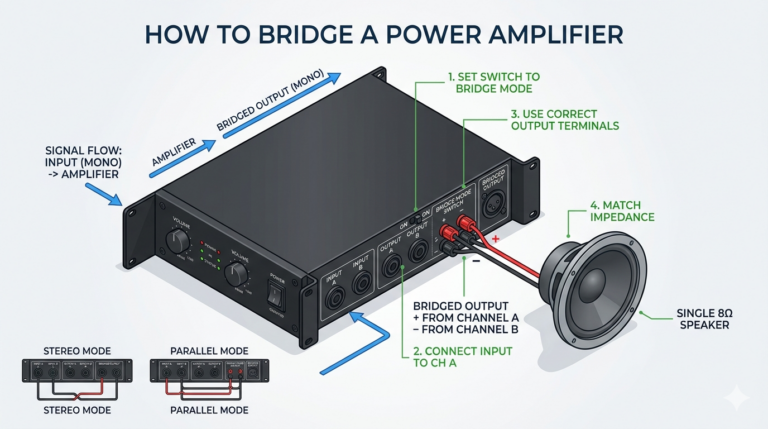
Is it better to bridge a stereo amplifier or use two channels for subwoofers?
While bridging a stereo amplifier can provide more power to a single subwoofer, using two channels to power two separate subwoofers often provides better overall performance. Two subwoofers can offer more even coverage, reduced localization, and potentially smoother frequency response across the listening area.
Additionally, operating an amplifier in stereo mode often provides better damping factor and thermal performance than bridged operation. For maximum flexibility, consider an amplifier powerful enough to drive your subwoofers effectively in stereo mode.