Best Wireless Microphone Systems Under $300 for Churches and Small Events
| KEY FACTS A quality wireless microphone system under $300 is now genuinely achievable from brands like Sennheiser, Shure, and Rode. For churches and small events, the most important factors are reliability, battery life, and range rather than sound quality alone. This price bracket is ideal for a single presenter or vocalist but is not designed for complex multi-channel setups.UHF systems generally outperform VHF systems in this price range for reliability and range. This guide reviews the best real-world options with honest assessments of their strengths and limitations. |
A few years ago, spending less than $300 on a wireless microphone system for church use meant accepting compromises that were difficult to live with in practice. Dropouts. Interference from other wireless devices. Battery life that could not be trusted through a full Sunday service. The range barely covered the stage, let alone the whole room.
That picture has changed. The wireless microphone market under $300 has been transformed by proper UHF technology reaching affordable price points and by brands like Rode entering the space with genuinely innovative products. There are now several systems in this price range that can serve a church or small event reliably without the compromises that used to be unavoidable.
I have used and tested wireless systems across a wide range of live events. In this guide, I am focusing specifically on systems that work in real church and small event environments, not just in controlled test conditions. I will tell you what each system does well, what it does not do well, and which type of user each one is best suited for.
What to Look For in a Wireless Microphone System Under $300
Before we look at specific products, here is what matters most in this price bracket for church and small event use.
- Frequency band: UHF (470 to 900 MHz) provides better range and more reliable interference rejection than VHF. In this price range, always choose UHF unless you have a specific reason not to.
- Range: For a small church or event space up to 30 metres, most systems in this bracket are adequate. For larger spaces, look for systems that specifically claim 60 metres or more of operating range and test them in your actual environment before relying on them.
- Battery life: A Sunday morning service with setup, rehearsal, and service can run four to six hours. Your wireless system needs to last that long comfortably. Look for systems with at least five hours of rated battery life from either AA batteries or a rechargeable pack, and factor in that real-world battery life is usually less than the manufacturer’s rated figure.
- Ease of operation: Church wireless systems are frequently operated by volunteers with limited technical experience. A system that requires complex frequency coordination or has a confusing interface is a liability. The best systems in this bracket turn on, pair automatically, and work without intervention.
- Microphone capsule quality: The quality of the microphone capsule in the handheld or headset that comes with the system matters enormously for sound quality. Budget wireless systems often save cost on the capsule, which is the component that determines how good the vocalist or speaker actually sounds.
- Number of channels: At this price point you are typically looking at single channel systems (one transmitter, one receiver). If you need two simultaneous wireless microphones, you will need to budget for two separate systems and ensure they can operate on different frequencies without interference.
The Best Wireless Microphone Systems Under $300
1. Sennheiser XSW 1-835 Dual: Best Overall for Churches
Price: approximately $230 to $280
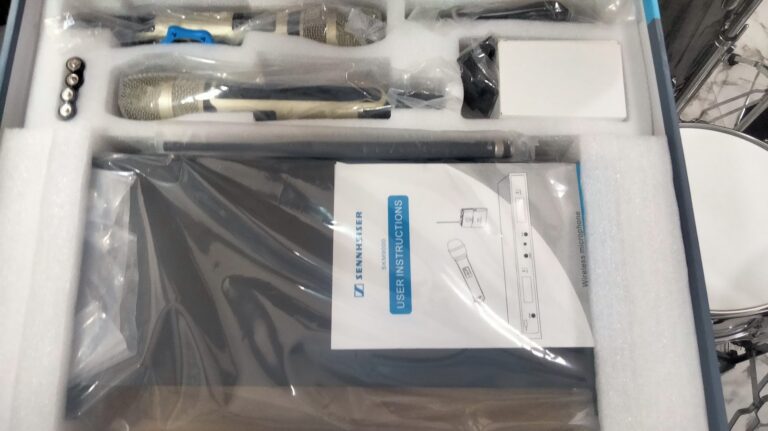
The Sennheiser XSW 1-835 Dual is a two-transmitter, one-receiver system that puts genuine Sennheiser quality into an accessible price bracket. The receiver handles two transmitters simultaneously, making it one of the best value propositions in the sub-$300 wireless market for any application that needs two wireless sources.
Frequency operation: UHF, operating in the 548 to 572 MHz range with 10 factory-set frequency channels. The system uses automatic frequency scan to find a clear channel on startup, which removes the complexity of manual frequency selection from volunteer operators.
Range: Rated at 100 metres in open conditions. In a typical church with walls, people, and interference from Wi-Fi networks and other wireless devices, real-world range is more like 30 to 50 metres, which covers the vast majority of small to mid-size church applications.
The microphone capsule: This is where Sennheiser’s heritage shows. The e835 capsule used in the XSW 1-835 handheld is a genuine Sennheiser e835 dynamic capsule, the same capsule used in Sennheiser’s respected wired e835 microphone. The sound quality is noticeably above what budget wireless systems typically deliver.
Real World Strengths
- Two transmitters on one receiver is exceptional value for churches with a pastor and a worship leader who both need wireless
- The e835 capsule provides professional-level vocal sound that flatters a wide range of voice types
- Automatic frequency scan on startup means volunteers do not need to understand RF frequency management
- Build quality is significantly better than competing systems at this price, with a proper metal receiver unit and a solid feel to the handheld transmitters
Real World Weaknesses
- Only 10 preset frequency channels means limited flexibility in RF-dense environments like large venues or urban churches with significant wireless interference
- Rechargeable batteries are not included. The system runs on standard AA batteries which is reliable but adds ongoing cost
- Bottom line: The XSW 1-835 Dual is the best purchase in this price bracket for a church that needs two wireless microphones for a pastor and worship leader. The combination of two transmitters, Sennheiser capsule quality, and simple operation makes it the most practical choice for volunteer-operated church environments.
2. Shure BLX288/PG58: Best Name Recognition and Support
Price: approximately $270 to $320
The Shure BLX288/PG58 is a dual-channel UHF system that comes with two PG58 handheld transmitters and a dual-antenna receiver. Shure’s BLX series uses their proprietary QuickScan frequency selection, which automatically identifies and locks onto a clear frequency with a single button press.
Frequency operation: UHF, with automatic frequency scanning. The BLX system operates in the 512 to 768 MHz range depending on the specific band version you purchase. Choose the band appropriate for your country’s RF regulations.
Range: Rated at 100 metres. Real-world range in indoor environments is similar to the Sennheiser, around 30 to 50 metres for reliable operation.
The microphone capsule: The PG58 capsule is a competent performer for speech and general vocals. It is not the most colourful or detailed capsule in Shure’s range, but it handles the frequency range clearly and without harshness. For speech reinforcement, it is entirely adequate. Vocalists with nuanced voices may prefer the Sennheiser e835 capsule.
Real World Strengths
- Shure’s global dealer and repair network means that if something goes wrong, support is accessible almost anywhere
- The BLX system has a long track record of reliable operation in church environments specifically
- QuickScan frequency selection is genuinely fast and simple to use
- Shure’s technical documentation and support resources are among the best in the industry, useful for technical volunteers who want to understand how the system works
Real World Weaknesses
- The PG58 capsule sounds less refined than the Sennheiser e835 capsule for critical vocal applications
- The system sits at the top of the $300 price range and sometimes exceeds it, depending on where you purchase
- Bottom line: The BLX288/PG58 is the right choice for a church that values brand familiarity, global support, and a long track record of reliability over marginal differences in vocal sound quality.
3. Rode Wireless GO II: Best for Flexibility and Modern Use Cases
Price: approximately $270 to $300
The Rode Wireless GO II is a genuinely innovative product in this price bracket. It is a compact two-channel wireless system where the transmitters are small clip-on units with built-in omnidirectional microphone capsules. They can be used as body-worn microphones on their own or connected to an external microphone via a standard 3.5mm input.
Frequency operation: 2.4 GHz digital wireless transmission rather than traditional UHF. This is an important distinction. The 2.4 GHz band is used by Wi-Fi networks and Bluetooth devices, and in environments with high Wi-Fi density, interference can be a concern. In most church environments this is not a significant issue, but in large venues with multiple access points and heavy Wi-Fi usage it is worth testing.
Range: Rated at 200 metres in open conditions. Practically, in indoor environments expect 30 to 70 metres depending on Wi-Fi interference levels.
Battery life: 7 hours from built-in rechargeable batteries with an included charging case that provides additional charges. The rechargeable system is a genuine practical advantage over AA battery systems for regular weekly church use.
Real World Strengths
- The built-in omnidirectional capsule on the transmitter body is excellent quality for a built-in microphone, well above what you would expect at this price
- The ability to connect any external microphone via 3.5mm makes the system enormously versatile. Connect a lapel microphone for a discreet presenter look, or a headset microphone for a worship leader who needs hands-free operation
- Rechargeable batteries with a case that charges the transmitters are far more practical for weekly church use than constantly replacing AA batteries
- On-board recording in the transmitter allows the signal to be recorded locally as a backup, which is genuinely useful for podcast and livestream productions
- The compact transmitter size is less obtrusive for speakers and presenters than a traditional handheld or standard bodypack transmitter
Real World Weaknesses
- 2.4 GHz operation can be less reliable than UHF in RF-dense environments. Test in your specific venue before relying on it
- The system is designed primarily around lapel and built-in microphone use rather than traditional handheld vocal microphone use. If you need a handheld microphone for singers, this is not the right choice
- Bottom line: The Wireless GO II is the best choice for churches where the primary use is amplifying a speaking pastor or presenter rather than a vocalist, particularly where the ability to also use a lapel microphone is valuable. It is also ideal for churches that produce video content or podcasts alongside the live service.
4. Behringer ULM302MIC: Best Budget Option for Very Tight Budgets
Price: approximately $80 to $120
The Behringer ULM302MIC is a 2.4 GHz digital wireless system that represents the lowest price point at which wireless operation is practically reliable. It uses 2.4 GHz digital transmission with automatic channel selection and offers up to 100 metres of operating range in open conditions.
I include this option because budget reality means some small churches cannot stretch to $250 to $300 even for a critical piece of equipment. At $80 to $120, the ULM302MIC works, but with more limitations than the higher-priced options.
Real World Strengths
- Genuinely affordable and works adequately in small spaces with limited Wi-Fi interference
- Simple operation with no frequency coordination required
- The price allows a church to try wireless operation before committing more budget to a better system
Real World Weaknesses
- The microphone capsule quality is noticeably below the Sennheiser and Shure options, with a slightly nasal character on vocals
- Range is less reliable than the UHF systems in challenging RF environments
- Build quality of the handheld transmitter is not suitable for heavy use
- Bottom line: A practical starting point for a very small church with a tight budget, but plan to upgrade within one to two years as the budget allows.
How to Maximise Reliability From Any Wireless System
Regardless of which system you choose, these practices will extend its reliable life and minimise the chance of problems during a service.
- Always do a full-range test before the service begins. Walk to the furthest point from the receiver that you will use during the service and confirm the signal is clean with no dropouts. Do not rely on the manufacturer’s stated range figure.
- Position the receiver antenna where it has a clear line of sight to the transmitter. Metal lecterns, concrete walls, and large human crowds all attenuate wireless signals. If the receiver is hidden behind an equipment rack or inside a closed cabinet, range will be reduced significantly.
- Check and replace or recharge batteries before every service. A wireless system that runs out of battery during a sermon is a serious disruption. Never start a service with a battery that has been used in a previous session without recharging or replacing it.
- Keep other wireless devices on different frequencies or channels from your microphone system. In-ear monitor systems, wireless instrument systems, and wireless DMX lighting controllers can all interfere with wireless microphones operating on nearby frequencies. Frequency coordination between all wireless devices in your system is essential as your wireless inventory grows.
- Store transmitters in a dry, temperature-stable environment. Wireless microphone transmitters contain electronics that are sensitive to moisture and temperature extremes. A bodypack transmitter stored in a hot car or a humid equipment bag will have a shorter reliable life than one stored in a stable indoor environment.
Frequently Asked Questions
Can I use two wireless systems from different brands simultaneously?
Yes, provided they operate on different frequencies that do not interfere with each other. UHF systems from different manufacturers operating on the same frequency band can interfere. Use the automatic frequency scan function on each system with all devices powered on to ensure they select different operating frequencies. Check that the selected frequencies are not overlapping before use.
Why does my wireless microphone crackle or drop out near the stage?
Dropouts near the stage are often caused by the transmitter passing through the null zone of the receiver antenna pattern, which is directly in front of or behind a standard antenna. A receiver placed directly behind or in line with the transmitter’s path of movement can cause dropouts at short range. Reposition the receiver so the antenna has a good angle to the transmitter throughout the performance area. Using a diversity receiver (which uses two antennas and selects the stronger signal) also significantly reduces dropout problems.
Is a wireless microphone system appropriate for a choir?
Individual wireless microphones for every choir member are impractical and expensive. For choir reinforcement, a better approach is to use one or two wired condenser microphones on stands positioned above and in front of the choir, or overhead choir microphone hangers suspended from the ceiling. Wireless microphones work best for individual soloists, worship leaders, and speakers.
How do I know when to replace the batteries in a wireless transmitter?
Most modern wireless receivers display the transmitter battery level on their front panel or LED indicators. Check this indicator at the start of every service and replace or recharge batteries that are below 50 percent capacity. Do not wait for the low battery warning to appear during a service. For AA battery systems, rechargeable NiMH batteries from quality brands like Eneloop provide excellent performance and reduce ongoing cost significantly.
Can I use a wireless microphone system outdoors?
Yes, but outdoor use presents additional challenges. Range is generally better outdoors due to the absence of walls and reflections, but exposure to moisture, wind, and extreme temperatures requires additional care. Use a windscreen on the microphone capsule to reduce wind noise. Protect transmitter bodypack units from sweat and moisture with a sweat-resistant bodypack cover or pouch. Ensure the receiver is protected from direct sunlight and is positioned to have clear line-of-sight to the transmitter’s operating area.