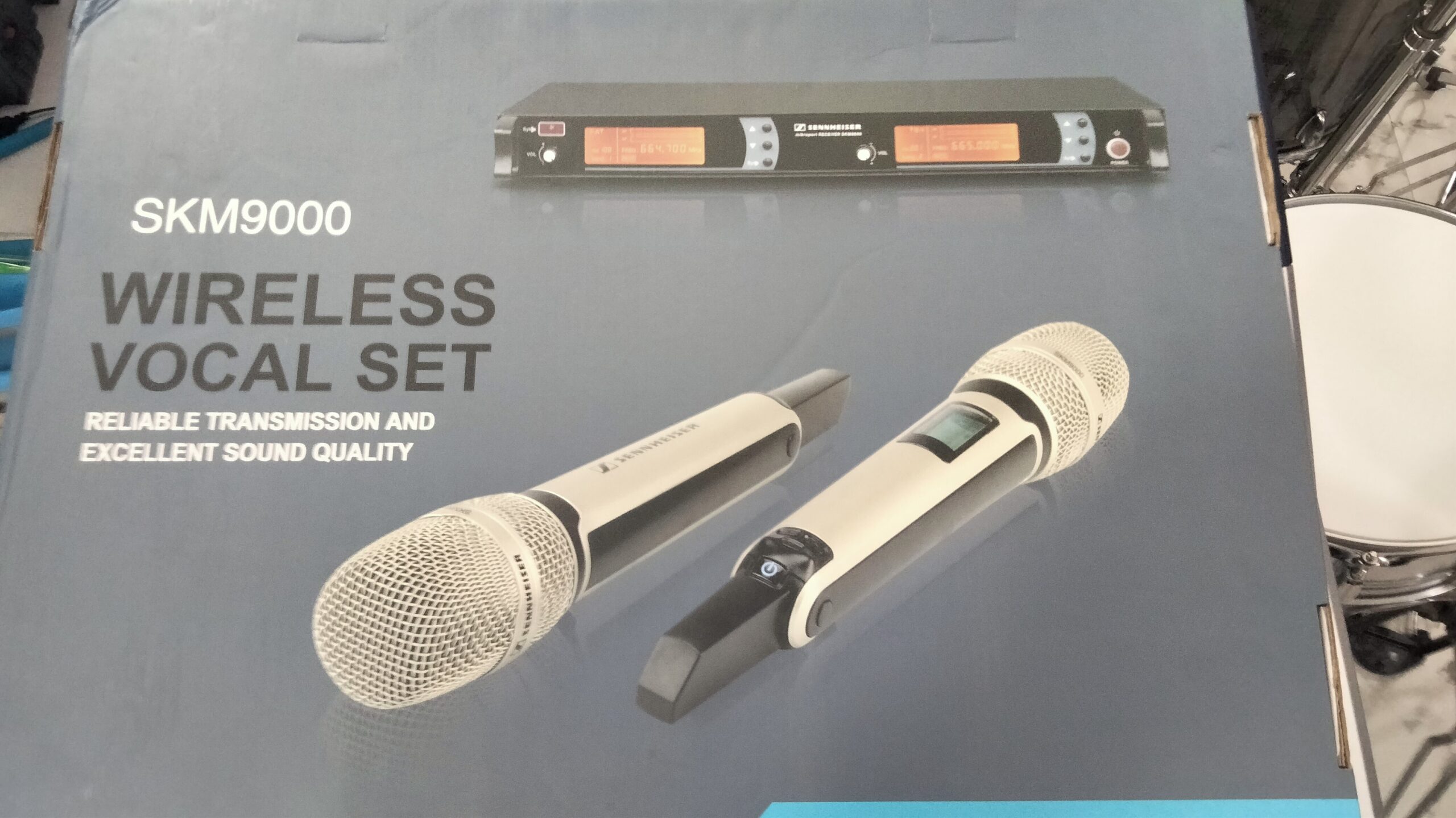
Sennheiser SKM 9000 Wireless Microphone: A Complete Review
The Sennheiser SKM 9000 stands as a premium digital handheld wireless microphone transmitter, engineered specifically to meet the uncompromising standards of high-end professional touring audio and broadcast environments.
Renowned for its structural versatility, rugged mechanical design, and pristine signal transmission, the SKM 9000 is the industry benchmark for major live televised events, stadium concert tours, and large-scale theatre productions.
As an audio engineer with over seven years of hands-on experience managing live sound reinforcement, complex stage RF deployment, and critical studio tracking sessions, I have had the privilege of working with top-tier wireless ecosystems.
From coordinating frequencies in hostile RF environments to riding faders on dynamic lead vocals, I can attest firsthand to the exceptional audio fidelity and RF robustness of this system. Below, we dive deep into its engineering features, physical performance capabilities, and real-world deployment scenarios.
Don’t forget to check out our Microphone Selector Tool—your quick solution for choosing the perfect mic for any venue or event! 🎤
Key Features
High-Definition Audio vs. Long-Range Modes
Unlike traditional analog wireless systems that rely on restrictive companding (compressing the audio before transmission and expanding it at the receiver), the SKM 9000 transmits pristine, uncompressed digital audio when operated in High Definition (HD) Mode.
This mode delivers a perfectly linear frequency response stretching from 80 Hz to 20 kHz with a massive dynamic range of 112 dB(A).
For exceptionally hostile or expansive arenas where physical distance threatens signal dropouts, the transmitter features an alternative Long Range (LR) Mode.
This setting utilizes Sennheiser’s proprietary SeDAC (Sennheiser Digital Audio Codec). SeDAC introduces artifact-free, data-reduced compression to maximize the transmitter’s raw range efficiency, stabilizing the digital stream over vast distances without suffering from the audible “breathing” or noise-floor pumping typical of older analogue companders.
Interchangeable Transducer Capsule Architecture
One of the transmitter’s greatest architectural strengths is its broad mechanical compatibility with an expansive array of interchangeable microphone heads.
Sound engineers are not locked into a single sonic signature; the SKM 9000 accommodates premium Sennheiser dynamic and condenser capsules, including the high-SPL MMD 9235, the tight supercardioid MMD 945-1, and even legendary studio-grade Neumann KK 204 (cardioid) and KK 205 (supercardioid) true condenser heads.
This flexibility allows you to adapt the physical transmitter package to flatter everything from delicate, airy soprano vocals to aggressive, high-transient speech.
Agile Frequency Tuning and Spectrum Flexibility
Operating across extensive UHF television frequency bands between 470 MHz and 798 MHz, the SKM 9000 boasts a wide switching bandwidth of 88 MHz. This wide window is critical for navigating crowded radio frequency environments.
The system is manually tuneable in ultra-precise 25 kHz steps, allowing RF coordinators to squeeze intermodulation-free channels into extremely narrow gaps inside tight local DTV (Digital Television) spectrum allocations.
Mechanical Build and Power Integration
Constructed out of a highly rugged, tour-grade metal alloy housing, the physical chassis is balanced symmetrically to sit comfortably in a performer’s hand while protecting the internal surface-mounted circuit boards from heavy stage impacts.
The system offers dual-modality power options: it can be paired with the BA 60 lithium-ion rechargeable battery pack or the B 60 battery pack housing 2 standard AA batteries. This configuration delivers up to 5.5 hours of continuous operation under heavy RF transmission loads.
Interface and Operational Safeties
The transmitter handles configuration via a backlit internal display screen that provides immediate data readouts of active RF mode, precise battery life tracking down to the minute, and active gain control settings (adjustable in fine 3 dB increments).
To ensure a flawless performance, the transmitter features an intentional mechanical lock mode. This safety prevents accidental power downs or setting alterations when a performer tightly grips the base of the handle.
| System Specification | HD (High Definition) Mode | LR (Long Range) Mode |
| Audio Transmission | Uncompressed 24-bit Digital Audio | SeDAC Proprietary Codec Compression |
| Dynamic Range | 112 dB (A) | ~104 dB (A) |
| RF Output Power | 10 mW (Continuous RMS) | 25 mW (Continuous RMS) |
| Ideal Deployment | Pristine Studio & Broadcast Stages | Large Arenas & Stadium Festivals |
Real-World Audio Performance and RF Stability
Uncolored Audio Fidelity
In live applications, the SKM 9000 excels by delivering completely transparent, uncolored audio. Because the HD mode bypasses analog compander circuits, high-frequency transients (like breath catches and sibilance) sound completely natural, and low-end proximity effects remain tight rather than turning muddy.
From my experience managing front-of-house sound during high-profile events, the linear response of this transmitter means you spend far less time carving out harsh frequencies with corrective channel EQs, allowing the native tone of a premium capsule to sit beautifully in a live mix.
RF Resilience and Linear Transmission Physics
The transmitter maintains an incredibly tight frequency stability of less than 5 ppm (parts per million). What sets the SKM 9000 apart from consumer wireless gear is its linear transmitter design. Standard wireless transmitters generate dangerous intermodulation products when multiple handhelds are used close to one another on a stage, forcing engineers to calculate complex, staggered frequency grids.
The SKM 9000’s output stage suppresses these intermodulation frequencies so effectively that you can line up your frequencies in a perfectly equidistant grid (spaced every 600 kHz apart) without risking self-interference.
During a demanding festival production where multiple wireless systems fought for clean air, this linear precision allowed us to pack our primary vocal channels tightly together, maintaining flawless audio continuity without a single dropout.
High-Pressure Ergonomics
When working inside fast-paced, high-pressure live television or broadcast environments, ease of configuration is everything.
The menu structure allows for rapid syncing with the EM 9046 receiver via infrared links. The external chassis coating minimizes physical handling noise, ensuring that when a speaker shifts their grip or paces across a stage floor, mechanical vibrations do not translate into low-end rumble through the sound system.
Ideal Use Cases
- High-Profile Live Performances: Exceptional for touring concert stages due to its high SPL handling and ability to project clear, undistorted vocal signals over dense instrument mixes.
- Televised Broadcasting: The uncompressed HD transmission stream perfectly matches the digital bitrates required by modern HD/4K broadcast trucks and digital console networks.
- Musical Theatre Productions: The mechanical versatility of interchangeable capsules combined with tight, equidistant frequency packing makes it a reliable tool for multi-channel theatrical cast configurations.
Personal Experience
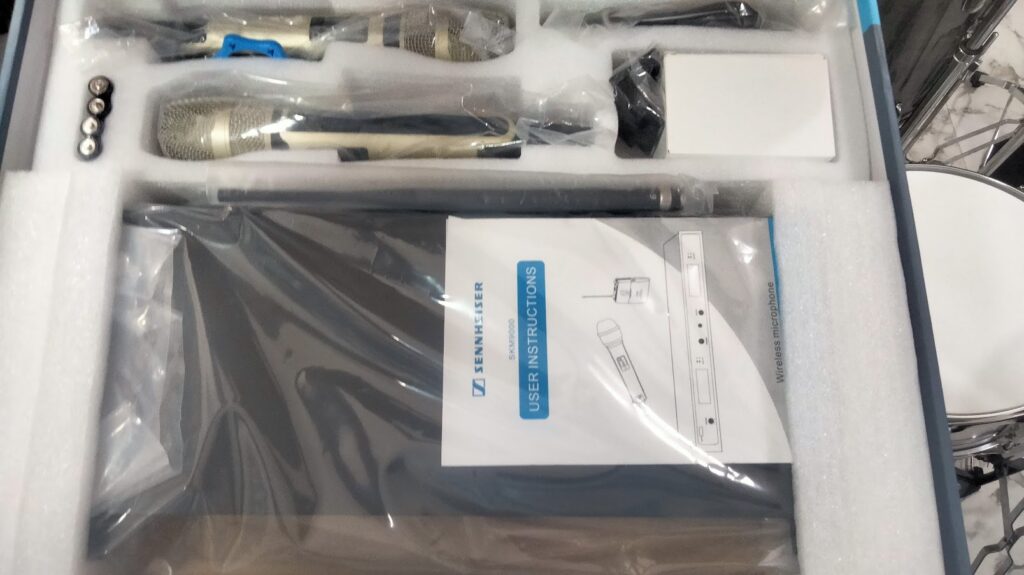
As a working audio engineer, I have put the Sennheiser SKM 9000 through rigorous real-world paces. I recall one distinct live outdoor performance where the lead vocalist possessed an extreme dynamic range, moving rapidly from quiet, breathy whispers to powerful, operatic crescendos. In an ordinary analog setup, those whispers would have danced dangerously close to the wireless noise floor, and the loud choruses would have risked squashing the compander.
The SKM 9000 captured the performance effortlessly. Every subtle nuance was preserved, and the transient peaks hit the digital console with full, natural dynamics, cutting through a dense pop band arrangement without requiring heavy channel compression. Additionally, during a multi-venue touring production, the rugged metal construction proved invaluable. Despite the inevitable drops, bumpy pack-outs in road cases, and high-humidity stages, the transmitter performed flawlessly night after night without a single component failure.
Pros and Cons
Pros
- Studio-grade, uncompressed 24-bit audio quality via high-definition digital transmission.
- Equidistant frequency spacing eliminates the need for complex intermodulation calculations.
- Seamless compatibility with world-class Sennheiser and Neumann capsule heads.
- Tour-proof metal construction with highly accurate battery monitoring down to the minute.
Cons
- High capital investment cost, making it a restrictive choice for small regional venues or budget-conscious local church systems.
- Symmetrical, robust housing results in a slightly larger and heavier handheld form factor compared to compact analog transmitters.
Frequently Asked Questions
1. How does the battery life of the SKM 9000 compare to other professional wireless systems?
The SKM 9000’s battery performance is highly competitive within the high-end digital wireless space. The BA 60 lithium-ion pack delivers approximately 5.5 hours of continuous operation. While this runtime is shorter than some legacy analog transmitters (which often run for 8 hours on AA cells due to lacking heavy digital processing processors), it is standard for premium transmitters handling uncompressed digital conversion. The precision of the remaining runtime indicator on the display screen provides a dependable metric for tech crews during long events.
2. Can the SKM 9000 be used alongside other wireless microphone brands without interference issues?
Yes, the SKM 9000 can easily coexist with other wireless ecosystems (like Shure Axient Digital or Lectrosonics systems) provided proper frequency coordination is executed. Because it can be tuned in precise 25 kHz increments and exhibits exceptional internal shielding, it acts as a polite neighbor in the RF spectrum. For best results, use professional software like Sennheiser Wireless Systems Manager (WSM) or Shure Wireless Workbench to calculate clean frequencies across mixed-manufacturer setups.
3. Is the SKM 9000 affected by changing UHF RF spectrum allocations?
Like all professional wireless gear operating within the UHF television band, the SKM 9000 is directly subject to local government spectrum regulations and regular frequency re-allocations. Sennheiser addresses this by manufacturing the SKM 9000 system in multiple distinct frequency blocks across the 470 MHz to 798 MHz range. When purchasing hardware, always cross-reference your region’s specific legal white space allocations to choose the safest operating frequency block.
4. How noticeable is the audio quality difference between HD mode and LR mode?
In a live front-of-house concert mix or a speech-heavy corporate venue, the sonic difference between HD and LR mode is virtually indistinguishable to the average listener. However, inside an acoustically treated broadcast booth or an analytical monitoring environment, an engineer will notice that HD mode preserves slightly better high-frequency transient detail (“air”) and offers a wider dynamic range. If your venue requires maximum range or faces heavy obstacle obstruction, switching to LR mode is an excellent trade-off, as its reliability far outweighs the micro-compromise in audio bandwidth.
5. What routine maintenance does the SKM 9000 require to preserve optimal stage reliability?
To maintain peak performance, keep the gold-plated battery contacts and capsule threads clean using specialized electronic contact cleaner (like DeoxIT) and a lint-free micro-cloth. Because condenser capsules are highly sensitive to moisture accumulation and vocal debris, always unscrew the outer grille cap after high-energy performances to allow the capsule to air-dry naturally. Additionally, ensure your system firmware is updated regularly via the receiver to maintain compatibility with updated battery management profiles.
Final Engineering Thoughts
The Sennheiser SKM 9000 remains a pinnacle achievement in professional wireless microphone technology, delivering an uncompromising combination of studio-grade sound quality, exceptional RF stability, and flexible capsule integration. Its ability to handle linear, equidistant frequency grids removes the logistical headaches of multi-channel coordination, making it an invaluable asset for technical directors and tour managers globally.
Drawing from years of experience in high-pressure live environments, I can confidently confirm that if your production budget allows, this wireless system is an investment that pays major dividends in operational peace of mind and pristine audio reproduction. If you are looking for a flagship wireless system that refuses to compromise on quality, the SKM 9000 sits firmly at the top of the list.
The Sennheiser SKM 9000 is a powerhouse in wireless microphone technology, offering unmatched sound quality, reliability, and versatility.